
- ISO/IEC 17025:2017 Accredited Laboratory
- NIST Traceable Calibration Certificates
- UV-Vis, NanoDrop, FTIR & Microplate Readers
- Wavelength & Photometric Accuracy Verified
- Nationwide Onsite & Mail-In Service
- CAP, CLIA, cGMP, GxP & GLP Documentation
- Stray Light, Linearity & Baseline Stability Testing
- Multi-Tiered Service Levels
Onsite or Mail-In ISO/IEC 17025 Accredited Calibration for All Spectroscopy & Photometric Instruments in Pharmaceutical, Biotech, and Clinical Laboratories
UV-Vis Spectrophotometer Calibration by Regulatory Environment
Compliance-focused guides to wavelength and photometric accuracy verification, stray light and linearity evaluation, measurement uncertainty, NIST SRM 930 traceability, and the ASTM E275 / USP <857> standards — written for your regulatory framework, whether you run a pharmaceutical GMP operation or a CAP/CLIA clinical laboratory.
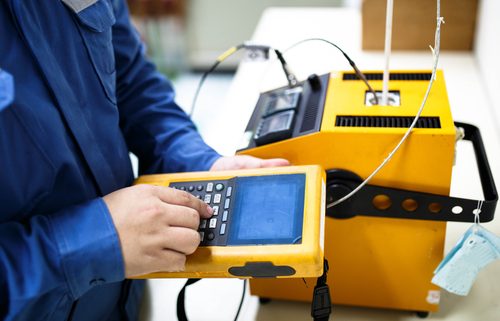
Spectroscopy & Photometric Instruments We Calibrate
Femto Scientific provides ISO/IEC 17025 accredited calibration, preventative maintenance, and repair for the full range of spectroscopy and photometric instruments used in pharmaceutical, biotech, clinical, and research laboratories.
- UV-Vis Spectrophotometers — single-beam, double-beam, and array-detector models; wavelength verification, photometric accuracy, stray light, and baseline stability per ASTM E169, E275, and NIST SRM 930
- NanoDrop & Microvolume Systems — NanoDrop One, NanoDrop 2000/2000c, and DeNovix; A260/A280 verification, pedestal path-length check, linearity, and nucleic acid quantification accuracy
- FTIR Spectrometers — Nicolet Summit, iS20, iS50; Shimadzu IRTracer-100; Jasco FT/IR series; wavelength accuracy, spectral resolution, interferometer alignment, ATR accessory verification, and spectral reproducibility
- Microplate Readers — single-mode and multi-mode readers; absorbance, fluorescence, and luminescence verification; plate uniformity testing; detector linearity; SpectraMax, Synergy, Infinite, and CLARIOstar series
- Visible Spectrophotometers — Hach DR3900, DR6000; Jenway 6800/7300 series; Unico UV-2100/SQ-2800; single- and dual-beam visible range instruments
- Fluorescence Spectrophotometers — excitation/emission wavelength accuracy, relative fluorescence intensity, sensitivity, and linearity verification
- Near-Infrared (NIR) Spectrometers — wavelength accuracy and photometric linearity for at-line and on-line NIR systems
- Spectrophotometer Accessories — ATR accessories, integrating spheres, fiber-optic probes, and cuvette holders serviced and verified
Spectrophotometer Calibration for All Major Manufacturers
All UV-Vis calibrations performed per ASTM E169, E275, and E387 using NIST-traceable SRM reference filters and certified wavelength standards. FTIR and NanoDrop calibrations per applicable ASTM, ISO, and manufacturer qualification procedures. A partial list of manufacturers we service:
- Thermo Scientific — Evolution 201/220/260 Bio; Genesys 10S/30/50/150; NanoDrop One; NanoDrop 2000/2000c; Nicolet iS5/iS10/iS20/iS50; Nicolet Summit
- Shimadzu — UV-1900/UV-2700 UV-Vis; IRTracer-100 FTIR; IRSpirit FTIR; UV-Vis spectrophotometer accessories
- Jasco — V-730/V-750/V-770 UV-Vis; FT/IR-4000/6000 series; J-1000 CD spectrometers
- Mettler Toledo — UV5 and UV7 UV-Vis spectrophotometers with cuvette and fiber-optic probes
- Hach — DR3900, DR6000, and DR900 portable colorimeters and spectrophotometers
- Jenway / Cole-Parmer — 6800, 7300, 7315, and 7205 series UV-Vis spectrophotometers
- Unico — UV-2100, UV-2150, SQ-2800 UV-Vis spectrophotometers and colorimeters
- Molecular Devices — SpectraMax M2/M3/M4/M5/i3x; SpectraMax 190/340 PC microplate readers
- BioTek / Agilent — Synergy H1/HTX/Neo2; Epoch; Cytation series multi-mode readers
- BMG Labtech / Tecan — CLARIOstar, PHERAstar, Infinite M200/F200; multimode reader platforms
- And many more — contact us if your brand is not listed above
What Is Included in Every Spectrophotometer Calibration Service
- Wavelength accuracy verification at multiple points using NIST-traceable holmium oxide or didymium reference filters
- Photometric accuracy (absorbance) testing using NIST SRM 930 or NIST SRM 2031 certified neutral density filters
- Stray light testing at critical wavelengths using NIST-traceable cut-off filters
- Baseline stability and detector noise evaluation
- Calibration sticker with unique barcode for laboratory asset tracking
- Environmental condition monitoring (temperature, humidity) during calibration
- Calibration certificate with as-left and/or as-found data (level-dependent)
- Happiness Guarantee on every service
Calibration sticker and basic performance verification — the standard choice for internal quality programs that do not require a regulatory compliance certificate.
| Service Includes | Level 1 | Level 2 | Level 3 | Level 4 |
|---|---|---|---|---|
| Wavelength Accuracy Verification | ✔ | ✔ | ✔ | ✔ |
| Photometric Accuracy (Absorbance) Test | ✔ | ✔ | ✔ | ✔ |
| Stray Light Testing | ✔ | ✔ | ✔ | ✔ |
| Baseline Stability & Noise Evaluation | ✔ | ✔ | ✔ | ✔ |
| Calibration Sticker with Barcode | ✔ | ✔ | ✔ | ✔ |
| Calibration Certificate with As-Left Data | – | ✔ | ✔ | ✔ |
| As-Found and As-Left Calibration Data | – | – | ✔ | ✔ |
| Documented Measurement Uncertainty | – | – | ✔ | ✔ |
| ISO/IEC 17025 Accredited Certificate | – | – | ✔ | ✔ |
| IQ/OQ Support Documentation | – | – | – | ✔ |
| Options | ||||
|
Express Turnaround
24 hr / 48 hr / 72 hr
|
✔ | ✔ | ✔ | ✔ |
| Onsite Service at Your Facility | ✔ | ✔ | ✔ | ✔ |
| Repair & Component Replacement | ✔ | ✔ | ✔ | ✔ |
| Preventative Maintenance | ✔ | ✔ | ✔ | ✔ |
| Customized Calibration Intervals | ✔ | ✔ | ✔ | ✔ |
Level 3 and Level 4 certificates satisfy CAP, CLIA, cGMP, GLP, GxP, and FDA 21 CFR Parts 58 and 211 documentation requirements for spectroscopy instruments used in regulated laboratory and pharmaceutical manufacturing environments. Level 4 certificates include IQ/OQ support documentation for GMP performance qualification programs.
Spectrophotometer Calibration for Regulated and GMP Laboratories
Femto Scientific’s ISO/IEC 17025 accredited certificates and documentation satisfy the spectrophotometer and photometric instrument calibration requirements of the most demanding regulatory frameworks in pharmaceutical, clinical, and research laboratory settings.
GMP, GxP & FDA 21 CFR Parts 58 & 211
cGMP and GLP programs require spectrophotometer calibration records with unbroken NIST traceability, documented measurement uncertainty, and as-found/as-left data for all instruments used in identity testing, dissolution, protein quantification, and spectral analysis. Our ISO/IEC 17025 accredited certificates satisfy FDA inspection requirements for UV-Vis, FTIR, and microplate reader instruments across pharmaceutical manufacturing and QC testing environments.
CAP & CLIA Clinical Laboratory Compliance
CAP and CLIA require documented, NIST-traceable calibration of spectrophotometric instruments used in diagnostic testing, reagent quantification, and specimen analysis. Our accredited certificates with as-found and as-left data satisfy CAP inspection checklists for spectrophotometers and microplate readers — delivered electronically to your QMS or LIMS for immediate audit readiness and inspection-ready documentation.
ISO 17025, NIST, ASTM E169 & USP <857>
All Femto Scientific UV-Vis calibrations are performed per ASTM E169 (UV-Vis standard practice), ASTM E275 (spectrophotometer testing), and ASTM E387 (stray radiant energy) using NIST-traceable certified reference materials including NIST SRM 930 and SRM 2031 neutral density filters. Our certificates satisfy USP Chapter <857> requirements for UV-Vis spectrophotometry and USP <197> requirements for IR spectroscopy in pharmaceutical applications.
Spectrophotometer Calibration Frequency Guidelines by Laboratory Type
Calibration frequency for spectroscopy instruments should reflect regulatory requirements, instrument criticality, usage intensity, and the consequences of measurement error. Instruments used in quantitative pharmaceutical testing, nucleic acid quantification, or diagnostic assays require more frequent calibration than those used in qualitative screening. Femto Scientific can help you establish and document an appropriate interval for your compliance program.
UV-Vis spectrophotometers and FTIR instruments used in GMP QC testing, dissolution, identity verification, and method validation are typically calibrated every 6 to 12 months, with performance verification (wavelength check, photometric check) performed more frequently per internal SOP requirements. Calibration intervals must be justified in instrument qualification documentation and are subject to FDA inspection review.
Clinical laboratories under CAP or CLIA are typically required to calibrate spectrophotometers and microplate readers used in diagnostic testing at least annually, with frequency determined by the laboratory’s quality system and CAP inspection requirements. High-throughput microplate readers and NanoDrop systems used in routine assays may require semi-annual calibration to maintain quantification accuracy.
Research and biotech laboratories typically calibrate UV-Vis spectrophotometers and NanoDrop systems annually. Laboratories generating data for regulatory submissions, publishing quantitative spectroscopy data, or operating under GLP guidelines should consider semi-annual calibration for instruments used in primary quantitative measurements to ensure data integrity throughout research and development programs.
NanoDrop and microvolume spectrophotometers used in nucleic acid quantification for next-generation sequencing, PCR, and gene expression studies require regular verification of A260/A280 accuracy and linearity. Annual ISO/IEC 17025 calibration combined with daily performance checks using manufacturer-supplied verification standards is the best practice to maintain nucleic acid quantification integrity for downstream molecular biology applications.
Frequently Asked Questions About UV-Vis Spectrophotometer Calibration
Femto Scientific provides ISO/IEC 17025 accredited calibration and preventative maintenance for UV-Vis spectrophotometers (single-beam, double-beam, and diode-array), NanoDrop and microvolume spectrophotometers (NanoDrop One, NanoDrop 2000/2000c, DeNovix DS-11), FTIR spectrometers (Thermo Nicolet, Shimadzu IRTracer, Jasco FT/IR series), microplate readers (absorbance, fluorescence, luminescence, and multi-mode; SpectraMax, Synergy, Infinite, CLARIOstar, PHERAstar), visible spectrophotometers (Hach DR series, Jenway, Unico), fluorescence spectrophotometers, and NIR spectrometers. We also service spectrophotometer accessories including ATR accessories, integrating spheres, and fiber-optic probes.
UV-Vis spectrophotometer calibration is governed by ASTM E169 (general UV-Vis techniques), ASTM E275 (UV-Vis-NIR instrument performance), ASTM E387 (stray radiant energy), and USP Chapter <857> (UV-Vis Spectrophotometry). Photometric accuracy is verified using NIST SRM 930 and SRM 2031. Wavelength accuracy is verified using NIST-traceable holmium oxide or didymium reference filters. FTIR calibrations follow ASTM E168 and manufacturer qualification protocols. NanoDrop calibration follows Thermo Fisher’s defined acceptance criteria and traceability procedures.
Pharmaceutical and GMP laboratories calibrate UV-Vis instruments every 6 to 12 months. Clinical laboratories under CAP or CLIA are typically required to calibrate spectrophotometric instruments at least annually. Research laboratories without regulatory mandates typically calibrate annually. NanoDrop systems benefit from annual ISO 17025 calibration plus periodic performance verification using manufacturer-supplied reference standards. Any instrument that produces anomalous results, is repaired, moved, or involved in an OOS investigation must be re-calibrated before return to service.
Yes. All Femto Scientific spectrophotometer calibration certificates document an unbroken chain of NIST traceability from your instrument to our NIST-certified reference materials (NIST SRM 930, SRM 2031 for photometric accuracy; holmium oxide and didymium standards for wavelength accuracy). ISO/IEC 17025 accredited certificates additionally include documented expanded measurement uncertainty (k=2, 95% confidence level), satisfying FDA, CAP, CLIA, and GMP audit requirements.
Yes. Femto Scientific provides onsite spectrophotometer calibration across major U.S. laboratory markets including New York City, New Jersey, Boston, Philadelphia, Baltimore, California (San Diego, Los Angeles, San Francisco), Texas (Houston), and many more metropolitan areas. Onsite service is available at all service levels. Mail-in calibration is available nationwide for portable instruments, NanoDrop systems, and compact microplate readers.
UV-Vis & Spectrophotometer Calibration Service Areas — Onsite & Nationwide Mail-In
Femto Scientific provides onsite spectrophotometer calibration in major laboratory markets across the United States. Laboratories outside our onsite territory can take advantage of our secure, fast-turnaround mail-in calibration service with NIST traceable ISO 17025 accredited certificates delivered electronically.
- New York City, New York (NY) – Manhattan
- Somerset, New Jersey (NJ)
- Boston, Massachusetts (MA)
- Cambridge, Massachusetts (MA)
- Philadelphia, Pennsylvania (PA)
- Baltimore, Maryland (MD)
- Bethesda, Maryland (MD)
- New Haven, Connecticut (CT)
- Hartford, Connecticut (CT)
- Providence, Rhode Island (RI)
- Newark, Delaware (DE)
- Manchester, New Hampshire (NH)
- Rochester, New York (NY)
- Richmond, Virginia (VA)
- Durham, North Carolina (NC)
- Charlotte, North Carolina (NC)
- San Diego, California (CA)
- San Francisco, California (CA)
- Los Angeles, California (CA)
- Denver, Colorado (CO)
- Houston, Texas (TX)
- Phoenix, Arizona (AZ)
- St. Louis, Missouri (MO)
- Cincinnati, Ohio (OH)
- Cleveland, Ohio (OH)
- Indianapolis, Indiana (IN)
Mail-in spectrophotometer calibration service is available to any laboratory in the United States. Contact us for shipping instructions, packaging guidance, and a service quote.