
Femto Scientific delivers ISO/IEC 17025 accredited UV-Vis spectrophotometer calibration built for FDA 21 CFR Part 211 and USP Chapter <857> — with verified wavelength and photometric accuracy, stray light and linearity, documented measurement uncertainty, and NIST SRM 930 traceability, so the spectrophotometers, NanoDrop systems, and microplate readers behind your identity testing, dissolution, and content-uniformity work pass inspection and your absorbance data holds up under audit.
- FDA 21 CFR Part 211 & Part 58 aligned records
- Documented measurement uncertainty (k=2)
- As-found & as-left data for change control
- Wavelength & photometric accuracy verified
- USP Chapter <857> performance compliance
- NIST SRM 930 / SRM 2031 traceable references
- Stray light, linearity & baseline stability
- Level 4 IQ/OQ support for GMP qualification
Accredited spectrophotometer calibration your quality unit can defend against a data-integrity finding.
Why GMP Laboratories Require ISO 17025 Accredited Spectrophotometer Calibration
In a cGMP environment, every UV-Vis spectrophotometer, NanoDrop, FTIR, and microplate reader is a measuring device whose wavelength and photometric accuracy flow directly into assay results, batch records, and release decisions. USP Chapter <857> and FDA 21 CFR Part 211 set the calibration expectations; ISO/IEC 17025 accreditation provides the documented uncertainty and NIST traceability that prove the calibration can actually demonstrate compliance.
FDA 21 CFR Part 211 & Part 58
Instruments must be calibrated on a written schedule with limits, results, and remedial action recorded. Our certificates capture the calibration date, results, NIST traceability, and as-found/as-left data your quality unit needs for Part 211 cGMP and Part 58 GLP instrument qualification programs.
USP Chapter <857> & ASTM E275
USP <857> sets wavelength accuracy, photometric accuracy, stray light, and resolution requirements for pharmaceutical UV-Vis instruments. We calibrate per ASTM E169, E275, and E387 using NIST SRM 930/2031 and holmium oxide references, documenting every parameter with reported uncertainty.
Data Integrity & Uncertainty
Without a reported measurement uncertainty, a certificate cannot demonstrate fitness for purpose. Accredited calibration with expanded uncertainty (k=2, 95%) gives you the attributable, accurate absorbance evidence auditors expect under ALCOA+ and 21 CFR Part 11.
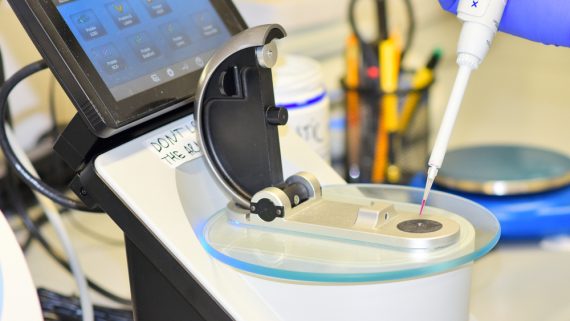
A Complete, Documented NIST-Traceable Calibration
Every accredited spectrophotometer calibration characterizes performance across the full measurement scale — not just a single wavelength — and records as-found data so an out-of-tolerance finding can be impact-assessed under change control.
- Wavelength accuracy via holmium oxide / didymium references
- Photometric accuracy via NIST SRM 930 / SRM 2031 filters
- Stray light, linearity & baseline stability
- UV-Vis, NanoDrop, FTIR & microplate readers
- As-found & as-left data with adjustment
- Expanded measurement uncertainty (k=2)
Compare service levels and documentation on the UV-Vis spectrophotometer calibration service page, or see our HPLC preventative maintenance & IQ/OQ/PQ for the chromatography qualification your analytical laboratory depends on.
Pharmaceutical & GMP UV-Vis Spectrophotometer Calibration FAQs
Wavelength accuracy is the agreement between the wavelength indicated by the instrument and the actual wavelength of light striking the detector. It is tested using NIST-traceable wavelength reference materials — typically holmium oxide solution or glass filters, which exhibit sharp absorption peaks at certified wavelength positions. Per ASTM E275 and USP <857>, pharmaceutical UV-Vis instruments must achieve wavelength accuracy of ±1 nm in the UV range (200–400 nm) and ±3 nm in the visible range. The calibration certificate documents the measured peak positions versus certified values at each tested wavelength.
Photometric accuracy is a spectrophotometer’s ability to report the correct absorbance value for a solution of known concentration or a reference filter of known transmittance. It is verified using NIST-certified neutral density glass filters (NIST SRM 930 or SRM 2031). Errors in photometric accuracy propagate directly through Beer-Lambert law calculations and produce systematic errors in all concentration results. A 2% photometric error produces a 2% concentration error in every sample measured. USP <857> requires photometric accuracy within ±0.005 Abs at 1 Abs and ±0.01 Abs at 2 Abs for pharmaceutical UV-Vis instruments.
Stray light is radiation at wavelengths other than the selected wavelength that reaches the detector and is counted as signal. It limits the linear dynamic range of the instrument by producing artificially low absorbance readings at high concentrations where the true absorbance would indicate zero transmittance. Stray light is tested per ASTM E387 using cut-off filters. USP <857> requires ≤0.01%T stray light at 198 nm and 220 nm for pharmaceutical UV-Vis instruments. High stray light levels cannot be corrected by calibration adjustment — they indicate a hardware issue requiring service or replacement.
Yes. FDA 21 CFR Part 211.68 requires that laboratory instruments used in GMP drug manufacturing and testing be calibrated at suitable intervals using standards with known accuracy. FDA 21 CFR Part 58 (GLP) has equivalent requirements for research laboratory instruments. FDA inspection warning letters have cited missing or inadequate UV-Vis calibration records as 483 observations. ISO/IEC 17025 accredited calibration certificates with documented NIST traceability and measurement uncertainty satisfy FDA inspection requirements and provide the documentation foundation for instrument qualification programs.
Measurement uncertainty (U) on a spectrophotometer calibration certificate quantifies the range within which the true value of the calibration result is believed to lie, at the 95% confidence level (k=2). It accounts for all identified sources of variability in the calibration process — reference material uncertainty, instrument repeatability, environmental conditions, and metrologist procedure. For photometric accuracy, a typical expanded uncertainty of U = 0.002 Abs (k=2) means the true absorbance value is within ±0.002 Abs of the reported value with 95% confidence. This information is essential for instruments near specification limits where a pass/fail decision requires knowing the uncertainty.
Put Your Spectrophotometers on a Defensible GMP Calibration Program
Tell us your instrument count, types, and required service level — we’ll return a quote with turnaround options and a recommended calibration interval for your compliance program.