
Femto Scientific provides ISO/IEC 17025 accredited spectrophotometer calibration that keeps clinical and diagnostic laboratories CAP- and CLIA-ready — NIST-traceable certificates with as-found and as-left data and documented uncertainty for the spectrophotometers, microplate readers, and NanoDrop systems behind your ELISA, clinical chemistry, reagent quantification, and diagnostic assays.
- Calibrated for accuracy your surveyor can verify
- NIST SRM 930 traceable photometric references
- As-found & as-left data on every certificate
- Documented measurement uncertainty (k=2)
- Survey- and inspection-ready documentation
- Onsite service for high-volume clinical labs
- Microplate reader & NanoDrop calibration
- Automatic recertification scheduling
Spectrophotometer calibration records your CAP inspector can check off without a second question.
Spectrophotometer Calibration Requirements for CAP and CLIA Laboratories
Clinical laboratories accredited by the College of American Pathologists (CAP) or operating under CLIA must calibrate the photometric instruments used in diagnostic testing with NIST-traceable standards and keep the records available for survey. ISO/IEC 17025 accredited calibration is the cleanest way to demonstrate that competency for every spectrophotometer, microplate reader, and NanoDrop system in your workflow.
CAP Survey Readiness
CAP checklist item GEN.41050 and related items require documented calibration of photometric instruments used in diagnostic testing. Our certificates document NIST-traceable calibration, the calibration date, as-found/as-left results, and reported uncertainty — exactly what surveyors expect for spectrophotometers and microplate readers.
CLIA 42 CFR 493.1252
CLIA requires instruments to be maintained and calibrated per manufacturer and quality-standard specifications, using NIST-traceable references within the established interval. Our accredited certificates meet those requirements and integrate directly with your LIMS.
Diagnostic Assays & Quantification
An out-of-tolerance spectrophotometer or microplate reader can shift an ELISA cutoff, a clinical-chemistry result, or a nucleic acid quantification. Accredited calibration with documented uncertainty and as-found data gives you the evidence to demonstrate measurement validity — and to scope any impact if an instrument is found out of tolerance.
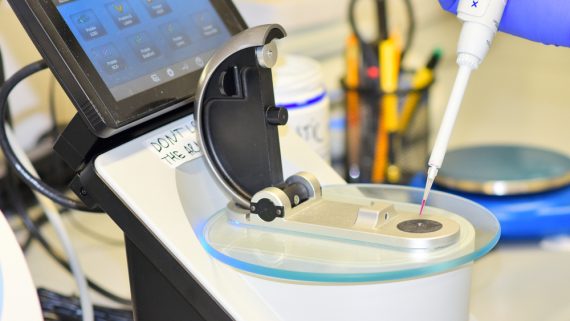
A Full Calibration, Not Just a Daily Performance Check
A daily performance check with a manufacturer standard confirms the instrument is roughly on scale; it is not a calibration. Accredited calibration characterizes wavelength and photometric accuracy across the measurement range with NIST-traceable references and documents it for CAP and CLIA compliance. Both belong in your quality program — serving different purposes.
- Wavelength & photometric accuracy across the clinical range
- Microplate reader plate uniformity & linearity
- NanoDrop A260/A280 & absorbance verification
- As-found & as-left data with adjustment
- Documented expanded uncertainty (k=2)
- Barcode stickers & electronic certificates for QMS
Most CAP and CLIA laboratories calibrate photometric instruments at least annually. Compare service levels and turnaround on the UV-Vis spectrophotometer calibration service page, or add NIST-traceable pH meter calibration for the rest of your clinical-chemistry bench.
CAP & CLIA UV-Vis Spectrophotometer Calibration FAQs
Yes. CAP (College of American Pathologists) checklist item GEN.41050 and related general checklist items require that laboratory instruments, including spectrophotometers and microplate readers used in diagnostic testing, be maintained and calibrated per manufacturer specifications and applicable regulatory standards, with documentation available during inspection. CAP expects calibration certificates with NIST traceability for instruments used in quantitative clinical measurements. ISO/IEC 17025 accredited calibration certificates with as-found and as-left data are the recommended documentation standard for CAP inspections involving spectroscopy instrumentation.
Yes. Femto Scientific calibrates single-mode and multi-mode microplate readers including Molecular Devices SpectraMax (M2, M3, M4, M5, i3x), BioTek/Agilent Synergy (H1, HTX, Neo2, Epoch, Cytation), Tecan Infinite (M200, F200), BMG Labtech CLARIOstar and PHERAstar. Our microplate reader calibration includes photometric accuracy, wavelength accuracy, plate uniformity testing (well-to-well CVs), linearity/dynamic range, and for multi-mode readers, fluorescence and luminescence channel performance verification. ISO/IEC 17025 accredited certificates with as-found and as-left data are available for CAP, CLIA, and GMP compliance programs.
Pharmaceutical and GMP laboratories calibrate UV-Vis instruments every 6 to 12 months. Clinical laboratories under CAP or CLIA are typically required to calibrate spectrophotometric instruments at least annually. Research laboratories without regulatory mandates typically calibrate annually. NanoDrop systems benefit from annual ISO 17025 calibration plus periodic performance verification using manufacturer-supplied reference standards. Any instrument that produces anomalous results, is repaired, moved, or involved in an OOS investigation must be re-calibrated before return to service.
Depending on the service level chosen, documentation delivered with Femto Scientific’s spectrophotometer calibration service includes: a calibration certificate documenting as-found and/or as-left data for each measured parameter, calibration sticker with barcode for instrument asset tracking, NIST traceability chain documentation for all reference materials used, documented expanded measurement uncertainty (ISO/IEC 17025 accredited certificates only), and for Level 4 services, IQ/OQ support documentation. All documentation is delivered electronically in PDF format and can be uploaded directly to your QMS or LIMS for inspection-ready audit management.
Yes. Femto Scientific provides onsite spectrophotometer calibration across major U.S. laboratory markets including New York City, New Jersey, Boston, Philadelphia, Baltimore, California (San Diego, Los Angeles, San Francisco), Texas (Houston), and many more metropolitan areas. Onsite service is available at all service levels. Mail-in calibration is available nationwide for portable instruments, NanoDrop systems, and compact microplate readers.
Keep Every Clinical Spectrophotometer Survey-Ready
Send us your instrument count and types — we’ll return a quote with turnaround options and a recommended calibration interval that keeps your laboratory inside CAP and CLIA requirements year-round.