
Femto Scientific delivers ISO/IEC 17025 accredited thermal cycler calibration and PCR thermal verification built for FDA 21 CFR Part 211 and 21 CFR Part 11 — with block temperature accuracy, well-to-well uniformity, ramp rate, and heated-lid data, documented measurement uncertainty, as-found/as-left records, and IQ/OQ/PQ documentation, so the thermal cyclers, qPCR, and RT-PCR instruments behind your assays pass qualification and your amplification data holds up under audit.
- FDA 21 CFR Part 211 & Part 11 aligned records
- Block temperature accuracy at your set points
- Well-to-well uniformity mapping (ΔTmax)
- Ramp rate & heated-lid verification
- Documented measurement uncertainty (k=2)
- As-found & as-left data for change control
- IQ/OQ/PQ documentation package (Level 4)
- NIST-traceable reference thermometry
Accredited PCR thermal verification your quality unit can defend against a data-integrity finding.
Why GMP Laboratories Require ISO 17025 Accredited Thermal Cycler Calibration
In a cGMP environment, every thermal cycler, qPCR, and RT-PCR instrument is a measuring device whose block temperature accuracy flows directly into amplification efficiency, assay data, and release decisions. FDA 21 CFR Part 211 and instrument qualification (IQ/OQ/PQ) set the calibration expectations; ISO/IEC 17025 accreditation provides the documented uncertainty and NIST traceability that prove the thermal verification can actually demonstrate compliance.
FDA 21 CFR Part 211 & IQ/OQ/PQ
Instruments must be calibrated on a written schedule with limits, results, and remedial action recorded. Our thermal verification captures block temperature accuracy, uniformity, ramp rate, and heated-lid data with as-found/as-left records — and our Level 4 service delivers the OQ documentation package your quality unit needs for Part 211 cGMP instrument qualification.
qPCR Validation & Amplification Efficiency
Block temperature accuracy and well-to-well uniformity directly govern amplification efficiency and Ct reproducibility. A systematic block error at annealing temperature can shift Ct values and distort quantification. We characterize thermal performance across your denaturation, annealing, and extension set points so your qPCR and RT-PCR assays stay validated.
Data Integrity & Measurement Uncertainty
Without a reported measurement uncertainty, a certificate cannot demonstrate fitness for purpose. Accredited thermal verification with expanded uncertainty (k=2, 95%) gives you the attributable, accurate temperature evidence auditors expect under ALCOA+ and 21 CFR Part 11 for PCR instrument qualification.
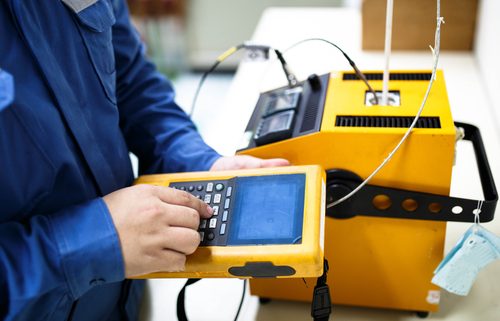
A Complete, Documented NIST-Traceable Thermal Verification
Every accredited thermal cycler calibration characterizes performance across your actual protocol set points — not just a single point — and records as-found data so an out-of-specification finding can be impact-assessed under change control.
- Block temperature accuracy at denaturation, annealing & extension set points
- Well-to-well uniformity (ΔTmax) across the block
- Heating & cooling ramp rate verification (°C/sec)
- Heated-lid temperature verification
- As-found & as-left data with expanded uncertainty (k=2)
- IQ/OQ/PQ documentation for GMP qualification
Compare service levels and documentation on the thermal cycler & PCR calibration service page, or see our CO2 & incubator calibration for the cell-culture environments your PCR workflows depend on.
Pharmaceutical & GMP Thermal Cycler Calibration FAQs
IQ/OQ/PQ (Installation Qualification / Operational Qualification / Performance Qualification) is a three-phase instrument validation framework used in FDA-regulated laboratories under 21 CFR Part 11 and ICH Q2(R2). For thermal cyclers: IQ documents that the instrument was installed correctly per manufacturer specifications; OQ verifies that the instrument operates within its performance specifications under controlled conditions — this is where thermal verification (block accuracy, uniformity, ramp rate, lid temperature) is conducted; PQ confirms the instrument performs consistently with actual assays in the user’s environment. Femto Scientific’s Level 4 service includes a comprehensive OQ documentation package with thermal verification data and NIST traceability to support your validation program.
Yes. Femto Scientific specializes in providing ISO/IEC 17025 accredited thermal cycler and PCR calibration services for biotechnology companies, pharmaceutical manufacturers, contract research organizations (CROs), and contract manufacturing organizations (CMOs). Our service documentation packages — including as-found and as-left data, measurement uncertainty statements, IQ/OQ documentation, and full NIST traceability — are designed to meet the rigorous instrument qualification requirements of cGMP, GLP, FDA 21 CFR, and ICH compliance programs. We have extensive experience supporting laboratory instrument qualification programs for BLA/NDA submissions, clinical study compliance, and process validation activities.
As-found data documents the thermal cycler’s temperature performance before any adjustment during the calibration service, providing a record of how the instrument was performing in your laboratory since the last calibration. This data is critical for GMP change control records, CAP checklists, and root cause analysis of any assay anomalies that occurred during the calibration interval. As-left data documents thermal performance after any adjustment or repair, representing the condition in which the instrument was returned to service. Both data sets together satisfy the before/after documentation requirements of instrument qualification programs and regulatory inspectors.
A Femto Scientific ISO 17025 thermal verification certificate includes: instrument identification (manufacturer, model, serial number, asset ID); calibration date and location; reference standard traceability information; environmental conditions (temperature, humidity) during calibration; programmed set points and measured block temperatures at each set point; temperature uniformity (ΔTmax) across the block; ramp rate measurements (heating and cooling); heated lid temperature data; as-found and as-left performance data (Level 3 and Level 4); documented expanded measurement uncertainty (k=2, 95% confidence level); and the ISO/IEC 17025 laboratory accreditation statement. Certificates are delivered electronically in PDF format for integration with QMS, LIMS, or electronic document management systems.
ISO/IEC 17025 accreditation means the calibration laboratory has been independently assessed and found technically competent by a recognized accreditation body. An ISO 17025 accredited thermal verification certificate includes documented measurement uncertainty — a requirement for instrument qualification under GMP, GLP, FDA 21 CFR, CAP, and CLIA programs. Without accreditation, a calibration certificate cannot demonstrate that the laboratory’s reference thermometry and measurement processes meet the technical competency requirements of regulatory frameworks. Femto Scientific’s ISO/IEC 17025 accredited certificates are accepted by FDA inspectors, CAP surveyors, and international quality auditors as evidence of thermal cycler performance and regulatory compliance.
Put Your Thermal Cyclers on a Defensible GMP Qualification Program
Tell us your instrument count, types, and required service level — we’ll return a quote with turnaround options, IQ/OQ documentation, and a recommended calibration interval for your compliance program.