
Femto Scientific provides ISO/IEC 17025 accredited thermal cycler calibration and PCR thermal verification that keeps molecular diagnostics laboratories CAP- and CLIA-ready — NIST-traceable certificates with as-found and as-left data and documented uncertainty for the thermal cyclers, qPCR, and RT-PCR instruments behind your high-complexity molecular assays and laboratory-developed tests (LDTs).
- CAP molecular pathology checklist support
- CLIA 42 CFR Part 493 high-complexity testing
- Block accuracy & well-to-well uniformity for Ct reproducibility
- As-found & as-left data on every certificate
- NIST-traceable reference thermometry
- Documented measurement uncertainty (k=2)
- LDT verification & assay reproducibility support
- Onsite service for high-volume core facilities
PCR thermal verification records your CAP inspector can check off without a second question.
Thermal Cycler Calibration Requirements for CAP and CLIA Molecular Laboratories
Molecular diagnostics laboratories accredited by the College of American Pathologists (CAP) or operating under CLIA must calibrate the PCR instruments that affect test results with NIST-traceable standards and keep the records available for survey. ISO/IEC 17025 accredited thermal verification is the cleanest way to demonstrate that competency for every thermal cycler, qPCR, and RT-PCR platform in your molecular workflow.
CAP Molecular Checklist Readiness
CAP checklists require NIST-traceable calibration records for instruments used in molecular pathology and clinical molecular testing, including PCR thermal cyclers. Our certificates document block temperature accuracy, uniformity, the calibration date, as-found/as-left results, and reported uncertainty — exactly what molecular pathology surveyors expect.
CLIA 42 CFR Part 493
CLIA requires instruments used in high-complexity molecular testing to be maintained and calibrated per manufacturer and quality-standard specifications, using NIST-traceable references within the established interval. Our accredited thermal verification certificates meet those requirements and integrate with your LIMS.
LDT Verification & Assay Reproducibility
An out-of-tolerance thermal cycler can shift Ct values and compromise a molecular assay or laboratory-developed test. Accredited calibration with documented uncertainty and as-found data gives you the evidence to demonstrate temperature validity — and to scope any impact if an instrument is found out of specification.
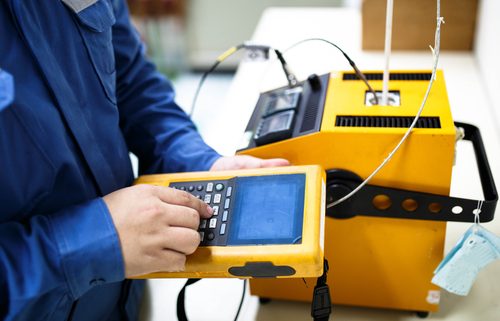
A Full Thermal Verification, Not Just a Single-Point Check
Confirming one set point is not a calibration. Accredited thermal verification characterizes block performance across your denaturation, annealing, and extension range with NIST-traceable references and documents it for CAP and CLIA compliance — the evidence your molecular quality program needs.
- Block temperature accuracy across the molecular assay range
- Well-to-well uniformity (ΔTmax) for Ct reproducibility
- As-found & as-left data with adjustment
- Documented expanded uncertainty (k=2)
- Barcode calibration stickers for asset tracking
- Electronic certificates for paperless QMS / LIMS
Most CAP and CLIA laboratories calibrate PCR instruments at least annually. Compare service levels and turnaround on the thermal cycler & PCR calibration service page, or review the pharmaceutical & GMP guide for IQ/OQ/PQ qualification requirements.
CAP & CLIA Thermal Cycler Calibration FAQs
The College of American Pathologists (CAP) Laboratory Accreditation Program (LAP) requires molecular pathology and clinical laboratories to maintain calibration records for all instruments that affect test results, including thermal cyclers used in PCR-based diagnostic assays. CAP checklists require that calibration be performed using NIST-traceable standards and that records include before and after (as-found and as-left) performance data. For high-complexity molecular testing under CLIA, thermal cycler calibration frequency must be documented in the laboratory’s standard operating procedures (SOPs) and demonstrated during CAP and CLIA inspections. Femto Scientific’s ISO 17025 accredited certificates include all documentation elements required for CAP and CLIA inspection readiness.
Yes. Femto Scientific provides thermal verification and calibration services for all qPCR (real-time PCR) platforms including Bio-Rad CFX96, CFX384, Applied Biosystems QuantStudio, Roche LightCycler, and all other real-time PCR systems. qPCR calibration verifies block temperature accuracy, well-to-well uniformity, and ramp rates — the parameters most directly affecting Ct reproducibility and amplification efficiency. Our ISO 17025 accredited thermal verification certificates for qPCR instruments include documented measurement uncertainty and the as-found and as-left thermal performance data required for instrument qualification and GMP compliance documentation.
Yes. Femto Scientific provides thermal verification for RT-PCR (reverse transcription PCR) instruments, which amplify RNA targets by first converting RNA to cDNA using reverse transcriptase, then amplifying the cDNA by PCR. RT-PCR instruments include both separate thermal cyclers used with standalone RT steps and one-step RT-qPCR platforms. Temperature accuracy is especially critical for RT-PCR because both the reverse transcription step (typically 42–60 °C) and the PCR amplification step require precise temperature control for efficient cDNA synthesis and specific amplification. Our thermal verification covers all temperature steps in the RT-PCR protocol.
In quantitative PCR, the cycle threshold (Ct) value is the PCR cycle number at which fluorescence crosses a defined threshold, used to calculate the original amount of target DNA or RNA. Block temperature accuracy and uniformity directly affect Ct values: a lower annealing temperature increases mispriming and background amplification, shifting Ct earlier; a higher annealing temperature reduces amplification efficiency, shifting Ct later. Even a 1 °C systematic block error can produce Ct shifts of 0.5–2 cycles, leading to quantification errors. Well-to-well non-uniformity causes Ct variability between replicates, increasing coefficient of variation (CV). Regular thermal verification ensures Ct values are reproducible between runs, instruments, and laboratories.
Calibration frequency depends on regulatory requirements, instrument criticality, and usage intensity. Pharmaceutical laboratories under cGMP typically verify thermal cyclers every 6 months. Clinical laboratories under CAP or CLIA should calibrate at least annually. Research laboratories without direct regulatory requirements typically calibrate annually. Any instrument that has been repaired, moved to a different location, experienced a significant environmental change, or produced anomalous assay results (unexpected Ct shifts, failed controls) should be re-verified before returning to critical use. High-use instruments in manufacturing or diagnostics may require quarterly verification.
Keep Every Clinical PCR Instrument Survey-Ready
Send us your instrument count and types — we’ll return a quote with turnaround options and a recommended calibration interval that keeps your molecular laboratory inside CAP and CLIA requirements year-round.