
Femto Scientific delivers ISO/IEC 17025 accredited pH meter calibration built for FDA 21 CFR Part 211 and USP Chapter <791> — with NIST-traceable buffer calibration, electrode slope and Nernst-response verification, ATC/MTC temperature compensation checks, and documented measurement uncertainty, so the pH data behind your buffer preparation, API synthesis, and final-product release testing holds up under audit.
- FDA 21 CFR Part 211.68 aligned records
- Documented measurement uncertainty (k=2)
- As-found & as-left data for change control
- Electrode slope & offset (asymmetry potential)
- USP Chapter <791> pH compliance
- NIST-traceable certified buffer solutions
- ATC/MTC temperature compensation verification
- Electronic certificates for QMS / LIMS
Accredited pH meter calibration your quality unit can defend against a data-integrity finding.
Why GMP Laboratories Require ISO 17025 Accredited pH Meter Calibration
In a cGMP environment, every pH measurement — buffer preparation, in-process pH control, and final product release testing — flows directly into batch records and release decisions. USP Chapter <791> and FDA 21 CFR Part 211 set the calibration expectations; ISO/IEC 17025 accreditation provides the documented uncertainty and NIST-traceable buffer traceability that prove the calibration can actually demonstrate compliance.
FDA 21 CFR Part 211.68
Automatic, mechanical, and electronic equipment used in manufacturing and testing must be calibrated on a written schedule with limits, results, and remedial action recorded. Our certificates capture the calibration date, buffer standards used, results, NIST traceability, and as-found/as-left data your quality unit needs for Part 211 cGMP calibration programs.
USP Chapter <791> & Buffer Traceability
USP <791> requires pH meters to be standardized against buffer solutions traceable to national standards at points that bracket the intended measurement range. We calibrate with NIST/IUPAC certified buffers (pH 4.00, 7.00, 10.00), document the full traceability chain, and verify electrode slope and offset at every point.
Data Integrity & Uncertainty
Without a reported measurement uncertainty, a certificate cannot demonstrate fitness for purpose. Accredited calibration with expanded uncertainty (k=2, 95%) and Nernst-slope verification gives you the attributable, accurate pH evidence auditors expect under ALCOA+ and 21 CFR Part 11.
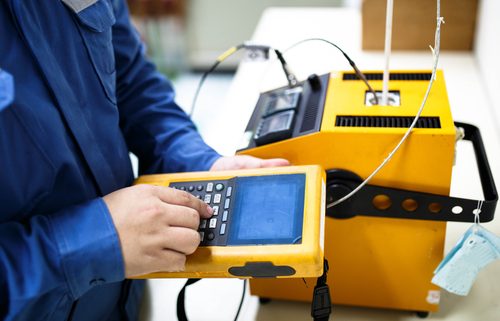
A Complete, Documented NIST-Traceable pH Calibration
Every accredited pH meter calibration characterizes electrode performance across your actual measurement range — not just a single midpoint — and records as-found data so an out-of-tolerance electrode can be impact-assessed under change control.
- Multi-point buffer calibration (pH 4.00, 7.00, 10.00)
- Electrode slope (Nernst response) verification
- Electrode offset (asymmetry potential) measurement
- ATC/MTC temperature compensation verification
- Expanded measurement uncertainty (k=2)
- As-found & as-left data with adjustment
Compare service levels and documentation on the pH meter calibration service page, or see our balance calibration service for the analytical weighing your GMP buffer preparation also depends on.
Pharmaceutical & GMP pH Meter Calibration FAQs
Yes. FDA 21 CFR Part 211.68 requires that pH meters used in pharmaceutical manufacturing and QC testing be calibrated with written procedures, and calibration records must be retained. Calibration must use certified reference standards (NIST-traceable buffer solutions) and must document the calibration date, results, and personnel. For GMP pH measurements with direct impact on product quality (API synthesis, buffer preparation, final product release pH testing), the calibration program should be part of the laboratory’s instrument qualification documentation and the calibration interval should be defined in the laboratory’s SOPs based on a risk assessment of the measurement’s criticality.
Electrode slope is the measure of how closely a pH electrode’s millivolt response follows the theoretical Nernst response of −59.16 mV/pH unit at 25 °C, expressed as a percentage. A slope of 95–105% indicates a healthy electrode; below 85% warrants replacement. A degraded slope causes systematic pH measurement errors that vary across the measurement range, producing acceptable accuracy near the calibration midpoint but increasing errors at pH values far from center. Slope documentation is required on calibration certificates for regulated laboratory programs.
Standard pH calibration uses NIST/IUPAC certified primary or secondary buffer solutions whose pH values are traceable to national standards. The most commonly used standard buffer values are pH 4.00 (potassium hydrogen phthalate buffer), pH 7.00 (phosphate buffer), and pH 10.00 (carbonate buffer), all at 25 °C. Femto Scientific uses NIST-traceable certified buffer solutions with COA documentation included in the calibration certificate, providing the complete buffer traceability chain required by GMP, EPA, CAP, and CLIA programs.
Automatic Temperature Compensation (ATC) uses a built-in or external temperature sensor to continuously measure the sample temperature and automatically adjusts the pH meter’s slope calculation using the temperature-corrected Nernst factor. Manual Temperature Compensation (MTC) requires the user to manually enter the sample temperature, after which the meter applies the corresponding temperature correction. ATC is preferred for samples at variable or non-ambient temperatures because it tracks temperature continuously during measurement; MTC is used when the exact sample temperature is known and stable. For pharmaceutical and clinical calibration, ATC function verification is performed during calibration to confirm the temperature sensor is reading accurately.
Measurement uncertainty is a quantified estimate of the range within which the true pH value is expected to lie, given all identified sources of measurement error. For pH meter calibration, uncertainty contributions include the certified pH uncertainty of the NIST-traceable buffer solutions, the repeatability of the meter’s response at each calibration point, temperature accuracy during calibration, and the meter’s display resolution. Femto Scientific’s ISO 17025 accredited certificates report expanded measurement uncertainty as U = X pH units at a coverage factor k=2 (approximately 95% confidence level), following the GUM (Guide to the Expression of Uncertainty in Measurement). This statement allows you to determine whether the pH meter’s readings are within specification for your specific application.
Put Your pH Meters on a Defensible GMP Calibration Program
Tell us your instrument count, types, and required service level — we’ll return a quote with turnaround options and a recommended calibration interval for your compliance program.