
Femto Scientific provides ISO/IEC 17025 accredited pH meter calibration that keeps clinical and diagnostic laboratories CAP- and CLIA-ready — NIST-traceable certificates with as-found and as-left data, electrode slope verification, and documented uncertainty for the pH meters behind your cell culture monitoring, blood gas QC, and clinical-chemistry buffer preparation.
- Calibrated to ensure accuracy for survey
- NIST-traceable certified buffer solutions
- As-found & as-left data on every certificate
- Documented measurement uncertainty (k=2)
- Survey- and inspection-ready documentation
- Onsite service for high-volume labs
- Electrode slope & response-time assessment
- Automatic recertification scheduling
pH calibration records your CAP inspector can check off without a second question.
pH Meter Calibration Requirements for CAP and CLIA Laboratories
Clinical laboratories accredited by the College of American Pathologists (CAP) or operating under CLIA must calibrate the instruments that affect test results with NIST-traceable standards and keep the records available for survey. ISO/IEC 17025 accredited calibration is the cleanest way to demonstrate that competency for every pH meter used in cell culture monitoring, blood gas QC, and clinical-chemistry assays.
CAP Survey Readiness
CAP laboratory accreditation program (LAP) checklists require documented calibration for all instruments that affect test results. Our certificates document NIST-traceable buffer calibration, the calibration date, as-found/as-left results, electrode slope, and reported uncertainty — exactly what surveyors expect to see for each pH meter.
CLIA 42 CFR 493.1255
CLIA requires laboratories to establish calibration schedules for all instruments used in test performance and to maintain records demonstrating compliance, using NIST-traceable references within the established interval. Our accredited certificates meet those requirements and integrate with your LIMS.
Temperature-Critical Assays & Culture pH
A degraded electrode or out-of-tolerance pH meter can shift a clinical assay or compromise cell culture media. Accredited calibration with documented uncertainty, slope verification, and as-found data gives you the evidence to demonstrate pH validity — and to scope any impact if an instrument is found out of tolerance.
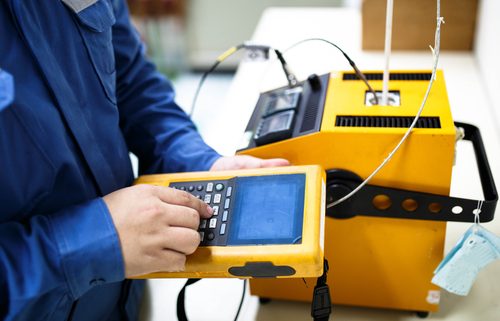
A Full Calibration, Not Just a Single-Buffer Check
A daily in-house buffer check confirms a single point; it is not a calibration. Accredited calibration characterizes electrode performance across your measurement range with NIST-traceable buffers and documents it for CAP and CLIA compliance. Both belong in your quality program — serving different purposes.
- Multi-point buffer calibration across the clinical range
- Electrode slope & offset (asymmetry potential)
- As-found & as-left data with adjustment
- Documented expanded uncertainty (k=2)
- Barcode calibration stickers for asset tracking
- Electronic certificates for paperless QMS
Most CAP and CLIA laboratories calibrate pH meters at least annually. Compare service levels and turnaround on the pH meter calibration service page, or see our thermometer calibration service for the incubators, water baths, and cold storage your clinical program also depends on.
CAP & CLIA pH Meter Calibration FAQs
Yes. CAP laboratory accreditation program (LAP) checklists for general chemistry and molecular testing require documented calibration for all instruments that affect test results. pH meters used in CAP-accredited laboratories for cell culture pH monitoring, buffer preparation for molecular assays, and clinical chemistry applications must have documented calibration records with NIST-traceable reference standards and retained for the accreditation inspection cycle. CLIA regulations for high-complexity testing (42 CFR Part 493.1255) require that laboratories establish calibration schedules for all instruments used in test performance and maintain records demonstrating calibration compliance. CAP surveyors and CLIA inspectors examine calibration records as part of their routine inspection protocols.
External ISO 17025 accredited calibration frequency depends on the laboratory type and regulatory requirements. Pharmaceutical laboratories under cGMP typically calibrate externally every 6–12 months, with in-house buffer checks performed daily or per session. Clinical laboratories under CAP or CLIA calibrate annually at minimum. Environmental and water quality laboratories follow EPA method-specific requirements. All laboratories should recalibrate after electrode replacement, after any repair, or when in-house checks show unexpected drift outside the laboratory’s established acceptable range.
NIST traceable pH calibration means that the buffer solutions used as calibration references have pH values that can be connected, through an unbroken chain of comparisons with documented uncertainties, to the pH standards maintained by the National Institute of Standards and Technology (NIST) — the U.S. national metrology institute responsible for maintaining primary measurement standards. NIST provides primary Standard Reference Materials (SRMs) for pH calibration (e.g., SRM 185h potassium hydrogen phthalate for pH 4) with certified pH values and uncertainties. Secondary buffer manufacturers calibrate their products against these SRMs; Femto Scientific uses NIST-traceable secondary buffer solutions with certificates of analysis that document the full traceability chain back to NIST primary standards.
Femto Scientific’s pH meter calibration certificate includes: instrument identification (manufacturer, model, serial number, asset tag); calibration date and location; reference standards used (buffer solutions with lot number, expiry date, and NIST traceability documentation); as-found pH readings at each calibration point (pre-calibration condition); as-left pH readings (post-calibration condition); electrode slope and offset data; temperature during calibration; acceptance criteria and pass/fail determination; calibration sticker information (next calibration due date); service engineer identification; and — for Level 3 and Level 4 certificates — expanded measurement uncertainty (U at k=2) and ISO/IEC 17025 accreditation certificate reference number. All documentation is provided in PDF format.
Yes. Femto Scientific provides onsite pH meter calibration and repair across major U.S. laboratory markets including New York, New Jersey, Boston, Philadelphia, Baltimore, Connecticut, California, Texas, and many more. Onsite service is ideal for large fleets, GMP facilities requiring witnessed calibration, or process and portable instruments. Depot calibration at our ISO 17025 accredited laboratory in Somerset, NJ is also available to any laboratory nationwide. Contact us to confirm scheduling and availability in your location.
Keep Every Clinical pH Meter Survey-Ready
Send us your instrument count and types — we’ll return a quote with turnaround options and a recommended calibration interval that keeps your laboratory inside CAP and CLIA requirements year-round.