
Femto Scientific delivers ISO/IEC 17025 accredited mass and weight set calibration built for FDA 21 CFR Part 211 and USP Chapters <41> and <1251> — with documented measurement uncertainty, as-found/as-left conventional mass data, air buoyancy correction, and unbroken NIST traceability, so the OIML E2 / F1 and ASTM Class 1 / 2 weights behind your analytical balance qualifications hold up under audit.
- FDA 21 CFR Part 211 & Part 58 aligned records
- Documented measurement uncertainty (k=2)
- As-found & as-left conventional mass data
- Air buoyancy correction on every measurement
- USP Chapter <41> & <1251> compliance
- NIST-traceable ASTM E617 & OIML R 111 calibration
- OIML E2 / F1 & ASTM Class 1 / 2 working standards
- Electronic certificates for QMS / LIMS
Accredited weight calibration your quality unit can defend against a data-integrity finding.
Why GMP Laboratories Require ISO 17025 Accredited Weight Calibration
In a cGMP environment, every calibration weight is a measuring device whose conventional mass flows directly into balance qualification, minimum weight determination, and release-critical weighings. USP Chapters <41> and <1251> and FDA 21 CFR Part 211 set the calibration expectations; ISO/IEC 17025 accreditation provides the documented uncertainty and NIST traceability that prove the calibration can actually demonstrate compliance.
FDA 21 CFR Part 211 & Part 58
Instruments — including calibration weight sets — must be calibrated on a written schedule with limits, results, and remedial action recorded. Our certificates capture the calibration date, results, NIST traceability, and as-found/as-left conventional mass data your quality unit needs for Part 211 cGMP and Part 58 GLP calibration programs.
USP <41>, <1251> & Balance Qualification
USP <41> requires certified, traceable weights to verify balance accuracy and repeatability; USP <1251> extends this to minimum weight and good weighing practice. We calibrate to ASTM E617 and OIML R 111 and document every denomination with reported uncertainty and pass/fail tolerance evaluation.
Data Integrity & Uncertainty
Without a reported measurement uncertainty, a certificate cannot demonstrate fitness for purpose. Accredited calibration with expanded uncertainty (k=2, 95%) and air buoyancy correction gives you the attributable, accurate mass evidence auditors expect under ALCOA+ and 21 CFR Part 11.
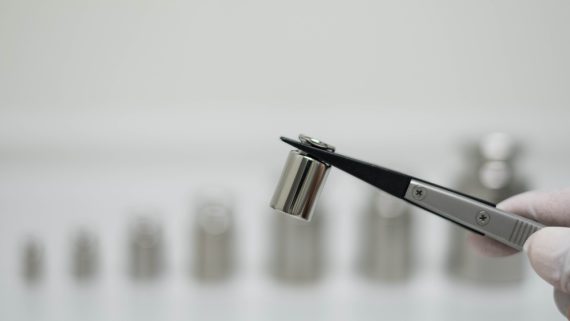
A Complete, Documented NIST-Traceable Mass Calibration
Every accredited weight calibration determines conventional mass by gravimetric comparison on a precision mass comparator, applies air buoyancy correction, and records as-found data so an out-of-tolerance finding can be impact-assessed under change control.
- Gravimetric comparison per ASTM E617 & OIML R 111
- ASTM Class 0–7 & OIML E1–M3 weights and sets
- Air buoyancy & air density correction
- As-found & as-left conventional mass with uncertainty
- Expanded measurement uncertainty (k=2)
- NIST-traceable reference standards
Compare service levels and documentation on the mass & weight set calibration service page, or see our balance calibration for the analytical balance qualifications your calibrated weights support.
Pharmaceutical & GMP Weight Calibration FAQs
Under FDA 21 CFR Part 211 (cGMP for pharmaceuticals) and 21 CFR Part 58 (GLP), calibration weight sets used in drug manufacturing and testing must have: (1) current calibration certificates with NIST traceability and documented measurement uncertainty; (2) calibration intervals established and justified in writing; (3) as-found data at each recertification (to support change control if the weight is found out of tolerance); and (4) documented procedures for handling out-of-tolerance findings, including impact assessment for balance calibrations performed with the weight since the last recertification. Femto Scientific’s ISO 17025 accredited certificates deliver all required documentation in electronic format for GMP QMS integration.
Pharmaceutical laboratories most commonly use ASTM Class 1 and Class 2 weight sets (or their OIML equivalents, E2 and F1) for analytical balance calibration and instrument qualification. ASTM Class 1 is used for semi-micro and microbalance programs where balances have readabilities of 0.01 mg or better. ASTM Class 2 covers most analytical balance programs (0.1 mg readability) used in pharmaceutical QC, compounding, and testing. Precision balance programs (1 mg readability and above) may use Class 3 or Class 4 weights. All classes used in pharmaceutical GMP environments must have current, NIST-traceable ISO/IEC 17025 accredited calibration certificates.
FDA does not explicitly mandate ISO 17025 accreditation in 21 CFR regulations, but FDA guidance and inspection expectations increasingly reflect the ISO 17025 standard as the appropriate framework for laboratory equipment calibration documentation. FDA inspectors evaluating calibration records for GMP compliance look for NIST traceability, documented measurement uncertainty, as-found and as-left data, and evidence of technical competency — all of which are verified by ISO 17025 accreditation. Femto Scientific’s ISO/IEC 17025 accredited weight calibration certificates have been accepted by FDA inspectors at pharmaceutical manufacturing facilities for equipment qualification documentation.
Measurement uncertainty in mass calibration quantifies the range of values within which the true conventional mass of the weight lies, at a stated confidence level (typically 95%). It combines contributions from reference weight uncertainty, mass comparator repeatability and resolution, buoyancy correction uncertainty, temperature effects, and other sources. ISO/IEC 17025 accredited certificates report expanded uncertainty (U, k=2), which represents approximately 95% confidence. This value must be smaller than the applicable ASTM or OIML class tolerance to confirm that the calibration can distinguish between a passing and failing weight.
As-found data documents the weight’s conventional mass value before any cleaning, handling, or adjustment during the recertification visit — representing the weight’s actual condition as it was being used in your laboratory. As-left data documents the final calibrated mass value after cleaning and any allowable adjustment, representing the weight’s condition when returned to service. Both datasets together provide the before/after documentation required by GMP change control programs, CAP inspection checklists, and equipment qualification protocols. An out-of-tolerance as-found finding triggers an impact assessment for balance calibrations performed since the previous recertification.
Put Your Weight Sets on a Defensible GMP Calibration Program
Tell us your weight classes, denominations, and required service level — we’ll return a quote with turnaround options and a recommended recertification interval for your compliance program.