
Femto Scientific provides ISO/IEC 17025 accredited mass and weight set calibration that keeps clinical and diagnostic laboratories CAP- and CLIA-ready — NIST-traceable certificates with as-found and as-left conventional mass data and documented uncertainty for the ASTM and OIML class weights you use to verify analytical and precision balances and run daily performance checks.
- NIST-traceable ASTM E617 & OIML R 111 calibration
- Certified class weights for balance verification
- As-found & as-left data on every certificate
- Documented measurement uncertainty (k=2)
- Survey- and inspection-ready documentation
- Weights for daily & periodic balance checks
- Onsite service for high-volume labs
- Automatic recertification scheduling
Weight calibration records your CAP inspector can check off without a second question.
Weight Calibration Requirements for CAP and CLIA Laboratories
Clinical laboratories accredited by the College of American Pathologists (CAP) or operating under CLIA must calibrate the measurement equipment used in testing — including the class weights that verify balance performance — with NIST-traceable standards, and keep the records available for survey. ISO/IEC 17025 accredited calibration is the cleanest way to demonstrate that competency for every certified weight in your program.
CAP Survey Readiness
CAP checklists require calibration records for measurement equipment used in critical processes, including the weights used to verify balance accuracy. Our certificates document NIST-traceable calibration, the calibration date, as-found/as-left conventional mass, and reported uncertainty — exactly what surveyors expect.
CLIA 42 CFR 493.1252
CLIA requires instruments to be maintained and calibrated per manufacturer and quality-standard specifications, using NIST-traceable references within the established interval. Our accredited ASTM E617 and OIML R 111 weight certificates meet those requirements and integrate with your LIMS.
Balance Verification & Daily Checks
An out-of-tolerance weight will make an accurate balance fail its verification — or hide a real balance error. Accredited calibration with documented uncertainty and as-found data gives you the evidence to trust your daily and periodic balance checks and to scope any impact if a weight is found out of tolerance.
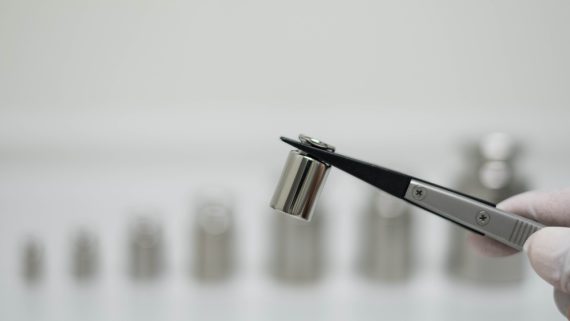
A Full Calibration, Not Just a Single-Point Check
A daily balance check confirms performance at a point; it is not a weight calibration. Accredited calibration determines each weight’s conventional mass by gravimetric comparison against NIST-traceable references and documents it for CAP and CLIA compliance. Both belong in your quality program — serving different purposes.
- Gravimetric comparison per ASTM E617 & OIML R 111
- Class weights for analytical & precision balances
- As-found & as-left conventional mass data
- Documented expanded uncertainty (k=2)
- Barcode calibration stickers for asset tracking
- Electronic certificates for paperless QMS
Most CAP and CLIA laboratories recertify calibration weights at least annually. Compare service levels and turnaround on the mass & weight set calibration service page, or see our clinical balance calibration for the instruments your certified weights verify.
CAP & CLIA Weight Calibration FAQs
NIST traceable weight calibration documents an unbroken chain of calibration comparisons from the calibrated weight back to the National Institute of Standards and Technology national mass standards. Femto Scientific’s mass reference standards are calibrated against NIST-certified reference masses on a documented recertification schedule. This traceability chain is required by FDA, CAP, CLIA, and ISO programs as evidence that the calibrated weights are metrologically valid for balance calibration and instrument qualification.
ISO/IEC 17025 accreditation is not legally mandated for all weight calibration use cases, but it is required or strongly preferred in many regulated contexts. FDA expects calibration laboratories used in GMP compliance programs to have demonstrated technical competency; ISO 17025 accreditation is the internationally recognized mechanism for demonstrating this competency. CAP requires that calibration laboratories servicing clinical laboratory equipment meet technical competency standards consistent with ISO 17025. For pharmaceutical, clinical, and government programs where the calibration documentation will be reviewed during regulatory inspections or audits, ISO 17025 accredited certificates are the most defensible and widely accepted form of evidence.
Reference standards (ASTM Class 0–1, OIML E1–E2): every 1–3 years. Working standards (ASTM Class 2–3, OIML F1–F2): annually. Field standards (ASTM Class 4–6, OIML M1–M2): every 6–12 months. Industrial weights: per quality system requirements. GMP programs require calibration intervals to be documented and justified in the equipment qualification file. Intervals should be shortened if as-found data shows consistent near-tolerance findings.
A complete ISO/IEC 17025 accredited weight calibration certificate from Femto Scientific includes: weight identification (nominal value, manufacturer, serial number, material); as-found and as-left conventional mass values with expanded uncertainty; ASTM E617 or OIML R 111 tolerance evaluation (pass/fail); reference standard identification and traceability statement; environmental conditions during calibration; calibration date; and the ISO/IEC 17025 accreditation identifier. Certificates are delivered electronically in PDF format, formatted for integration with pharmaceutical QMS and laboratory information management systems (LIMS).
The required ASTM weight class depends on the balance readability and the relevant standard or regulatory requirement. As a general rule: analytical balances with 0.1 mg readability require at minimum ASTM Class 2 (or OIML F1) reference weights; semi-micro balances with 0.01 mg readability require ASTM Class 1 (or OIML E2); microbalances with 0.001 mg readability require ASTM Class 0 or OIML E1/E2 weights. USP Chapter <1251> specifies ASTM Class 1 or OIML F1 or better for reference weights used in analytical balance performance checks. Verify the requirement in your SOP, the balance manufacturer’s specification, or the applicable regulatory standard.
Keep Every Clinical Weight Set Survey-Ready
Send us your weight classes and denominations — we’ll return a quote with turnaround options and a recommended recertification interval that keeps your laboratory inside CAP and CLIA requirements year-round.