
Femto Scientific delivers ISO/IEC 17025 accredited humidity and temperature calibration built for FDA 21 CFR Part 211, USP <1079>, and ICH Q1A stability programs — multi-point RH calibration with documented measurement uncertainty, as-found/as-left data, and unbroken NIST traceability, so the humidity probes, transmitters, and data loggers behind your stability chambers, cleanrooms, and controlled storage pass inspection and your environmental data holds up under audit.
- FDA 21 CFR Part 211.68 & Part 58 aligned records
- Documented measurement uncertainty (k=2)
- As-found & as-left data for change control
- Multi-point RH calibration at your set points
- USP <1079> & ICH Q1A stability alignment
- NIST-traceable RH reference standards
- Combination humidity/temperature probe calibration
- Electronic certificates for QMS / LIMS
Accredited humidity calibration your quality unit can defend against a data-integrity finding.
Why GMP Laboratories Require ISO 17025 Accredited Humidity Calibration
In a cGMP environment, every humidity probe, transmitter, and data logger is a measuring device whose accuracy flows directly into stability data, storage records, and release decisions. FDA 21 CFR Part 211 and USP <1079> set the calibration expectations; ISO/IEC 17025 accreditation provides the documented uncertainty and NIST traceability that prove the calibration can actually demonstrate compliance.
FDA 21 CFR Part 211.68 & Part 58
Automatic, mechanical, and electronic equipment used to monitor drug-product manufacturing and storage — including humidity sensors — must be routinely calibrated on a written schedule with limits, results, and remedial action recorded. Our certificates capture the calibration date, results, NIST traceability, and as-found/as-left data your quality unit needs for Part 211 cGMP and Part 58 GLP calibration programs.
USP <1079> & ICH Q1A(R2)
USP <1079> requires equipment that monitors storage and shipping conditions to be qualified and calibrated, and ICH Q1A(R2) requires stability-study chambers to be monitored with calibrated instruments. We perform multi-point RH calibration at the set points that bracket your stability and storage conditions and document every point with reported uncertainty.
Data Integrity & Uncertainty
Without a reported measurement uncertainty, a certificate cannot demonstrate fitness for purpose. Accredited humidity calibration with expanded uncertainty (k=2, 95%) gives you the attributable, accurate RH evidence auditors expect under ALCOA+ and 21 CFR Part 11 for controlled-environment monitoring systems.
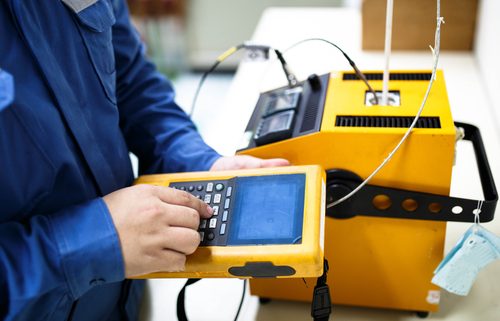
A Complete, Documented Multi-Point RH Calibration
Every accredited humidity calibration characterizes performance across your actual use range — not just a single point — and records as-found data so an out-of-tolerance finding can be impact-assessed under change control before it reaches your stability or storage records.
- Multi-point RH calibration at your chamber set points
- Humidity probes, RH transmitters & combination probes
- Data loggers for stability & storage monitoring
- As-found & as-left data with adjustment
- Expanded measurement uncertainty (k=2)
- Simultaneous temperature-channel calibration
Compare service levels and documentation on the humidity & temperature calibration service page, or see our temperature & humidity mapping for the chamber and storage studies your calibrated probes support.
Pharmaceutical & GMP Humidity Calibration FAQs
FDA 21 CFR Part 211.68 requires calibration of equipment used in pharmaceutical manufacturing and storage, including environmental monitoring instruments. USP <1079> addresses calibration of storage monitoring equipment for pharmaceuticals. FDA guidance documents for GMP facilities and stability study protocols (ICH Q1A) require calibrated instruments for controlled environment monitoring. Femto Scientific’s Level 4 calibration service provides GMP-compliant documentation meeting all these requirements.
Measurement uncertainty for humidity calibration is a quantitative statement of the doubt associated with a humidity measurement result, expressed as an expanded uncertainty (U) at a specified coverage factor (typically k=2, corresponding to approximately 95% confidence level). For humidity calibration, expanded uncertainty values typically range from ±0.5 % RH to ±2 % RH depending on the reference standard used, the calibration points, and the calibration method. ISO/IEC 17025 accredited calibration laboratories are required to evaluate and report measurement uncertainty on every accredited calibration certificate. A documented uncertainty statement is essential for determining whether a sensor’s as-found error is within specification with the required level of statistical confidence — and is increasingly required by FDA inspectors and CAP surveyors reviewing calibration records for controlled environment monitoring systems.
For most laboratory and controlled storage applications, a three-point calibration at 11 % RH, 33 % RH, and 75 % RH is sufficient. This covers the typical operating range of 20–80 % RH. For sensors operating in extended ranges, sensors used in critical GMP applications, or sensors where accuracy at the extremes is critical, a five-point or seven-point calibration is recommended. Calibration requirements should be defined in the sensor’s equipment qualification plan or SOPs.
ISO 17025 accredited humidity calibration laboratories use NIST-traceable saturated salt solutions (LiCl, MgCl₂, NaCl, K₂SO₄, and others), NIST-traceable chilled mirror hygrometers, or two-pressure/two-temperature humidity generators as reference standards. Each reference must have a valid NIST-traceable calibration certificate establishing an unbroken traceability chain to national humidity and temperature measurement standards.
Yes. Femto Scientific provides calibration services for individual sensors within environmental monitoring networks as well as complete EMS system sensor fleets. For onsite service, we can calibrate all sensors in a facility in a single visit, minimizing system downtime. Calibration certificates are issued for each sensor position and include all data required for EMS qualification and periodic review documentation under GMP and validation program requirements.
Put Your Humidity Sensors on a Defensible GMP Calibration Program
Tell us your instrument count, types, and required service level — we’ll return a quote with turnaround options and a recommended calibration interval for your compliance program.