
Femto Scientific provides ISO/IEC 17025 accredited humidity and temperature calibration that keeps clinical and diagnostic laboratories CAP- and CLIA-ready — NIST-traceable certificates with as-found and as-left data and documented uncertainty for the humidity probes, sensors, and data loggers guarding your reagent and specimen storage, refrigerators, incubators, and controlled-environment monitoring systems.
- Calibrated to ensure accuracy for survey
- NIST-traceable RH reference standards
- As-found & as-left data on every certificate
- Documented measurement uncertainty (k=2)
- Survey- and inspection-ready documentation
- Onsite service for high-volume labs
- Reagent & specimen storage monitoring calibration
- Automatic recertification scheduling
Humidity and temperature records your CAP inspector can check off without a second question.
Humidity Calibration Requirements for CAP and CLIA Laboratories
Clinical laboratories accredited by the College of American Pathologists (CAP) or operating under CLIA must calibrate the environmental monitoring instruments that control storage conditions with NIST-traceable standards and keep the records available for survey. ISO/IEC 17025 accredited calibration is the cleanest way to demonstrate that competency for every reagent refrigerator, specimen freezer, incubator, and controlled-environment monitor.
CAP Survey Readiness (LAP)
CAP accreditation program (LAP) checklists require documented calibration of environmental monitoring instruments with NIST-traceable reference standards and established calibration intervals. Our certificates document NIST-traceable calibration, the calibration date, as-found/as-left results, and reported uncertainty — exactly what surveyors expect in a CAP survey binder.
CLIA 42 CFR 493.1252
CLIA requires instruments to be maintained and calibrated per manufacturer and quality-standard specifications, using NIST-traceable references within the established interval. Our accredited humidity and temperature certificates meet those requirements and integrate directly with your LIMS and inspection documentation.
Reagent & Specimen Storage Environments
An out-of-tolerance humidity sensor can compromise reagent, control, and specimen storage or a temperature-critical assay. Accredited calibration with documented uncertainty and as-found data gives you the evidence to demonstrate storage validity — and to scope any impact if an environmental monitoring sensor is found out of tolerance.
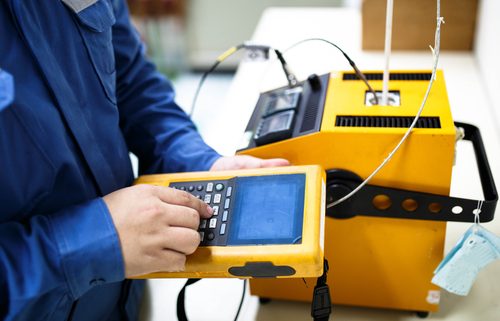
A Full Calibration, Not Just a Single-Point Spot Check
An in-house spot check confirms a single point; it is not a calibration. Accredited calibration characterizes performance across your use range with NIST-traceable references and documents it for CAP and CLIA compliance. Both belong in your quality program — serving different purposes.
- Multi-point RH calibration across the clinical range
- Humidity probes, sensors & combination probes
- Data loggers & environmental monitoring sensors
- As-found & as-left data with adjustment
- Documented expanded uncertainty (k=2)
- Electronic certificates for paperless QMS
Most CAP and CLIA laboratories calibrate environmental monitoring equipment at least annually. Compare service levels and turnaround on the humidity & temperature calibration service page, or add continuous ARTEMIS remote temperature & humidity monitoring for your reagent and specimen storage.
CAP & CLIA Humidity Calibration FAQs
CAP accreditation program (LAP) checklists require documented calibration of environmental monitoring instruments with NIST-traceable reference standards and established calibration intervals. CLIA regulations require that clinical laboratories maintain environmental monitoring equipment in good working order with documented calibration. Femto Scientific’s certificates are formatted for direct inclusion in CAP survey binders and CLIA inspection documentation.
Humidity probe and sensor calibration frequency depends on the laboratory type, regulatory requirements, and criticality of the monitored environment. Pharmaceutical facilities under cGMP typically calibrate humidity sensors every 6–12 months, with calibration intervals defined in the sensor’s qualification plan and environmental monitoring SOP. Clinical laboratories under CAP or CLIA typically calibrate annually at minimum, with more frequent calibration for sensors monitoring critical storage areas. Research and general laboratory sensors should be calibrated annually. All humidity sensors should be recalibrated after physical relocation, after any repair or sensor replacement, or when trending data shows performance drift outside established acceptance criteria. Calibration intervals should be documented in the laboratory’s quality system.
NIST traceability means that the calibration result is linked to national measurement standards maintained by the National Institute of Standards and Technology through an unbroken chain of calibrations, each with documented uncertainty. For humidity, this chain typically runs: NIST primary humidity standards → accredited transfer laboratory reference hygrometer → Femto Scientific working reference → sensor under test. NIST traceability on the calibration certificate provides the legal and regulatory evidence that the calibration result is referenced to recognized national standards.
Yes. Femto Scientific provides onsite humidity and temperature sensor calibration across major U.S. laboratory markets including New York, New Jersey, Boston, Philadelphia, Baltimore, Connecticut, California, Texas, and many more. Onsite service is ideal for laboratories with large fleets of humidity probes and data loggers, for GMP facilities requiring witnessed calibration or complete environmental monitoring system calibration, and for fixed installation sensors in cleanrooms, cold rooms, and stability chambers that cannot be easily removed. For laboratories outside our direct service territory, we offer depot calibration at our ISO 17025 accredited laboratory in Somerset, NJ. Contact us to confirm scheduling availability in your location.
Femto Scientific calibrates all types of humidity and temperature sensors including capacitive polymer humidity probes, RH transmitters, combination humidity/temperature data loggers, handheld humidity meters, and fixed-installation environmental monitoring sensors. We service all major manufacturers including Vaisala, Rotronic, Testo, Dickson, Onset HOBO, REES Scientific, Omega Engineering, Thermo Scientific, and others. Contact us if your specific make or model is not listed.
Keep Every Clinical Humidity Sensor Survey-Ready
Send us your instrument count and types — we’ll return a quote with turnaround options and a recommended calibration interval that keeps your laboratory inside CAP and CLIA requirements year-round.