
- ISO/IEC 17025:2017 Accredited Calibration Laboratory
- NIST Traceable Calibration Certificates
- 25+ Years of Laboratory Incubator Calibration Experience
- All Makes and Manufacturers Serviced
- Nationwide Onsite & Mail-In Service
- CAP, CLIA, cGMP, and GxP Compatible Documentation
- CO2 Verification, Temperature Mapping & Humidity Verification
- IQ/OQ/PQ Validation Documentation Available
Onsite Service or Mail-In to Our State-of-the-Art ISO/IEC 17025 Accredited Laboratory
CO2 Incubator Calibration by Regulatory Environment
Compliance-focused guides to multi-point temperature mapping, CO2 concentration and humidity verification, IQ/OQ/PQ validation, measurement uncertainty, and NIST traceability — written for your regulatory framework, whether you run a pharmaceutical GMP operation or a CAP/CLIA clinical laboratory.
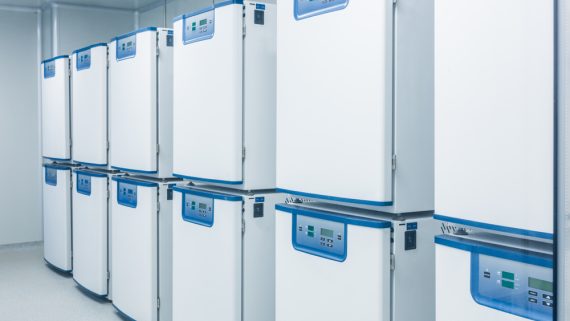
CO2 Incubator and Microbiological Incubator Calibration for All Major Manufacturers
All calibrations using NIST-traceable reference gas analyzers, multi-point thermometers, and hygrometers. A partial list of manufacturers and models we service:
- Thermo Scientific — Forma, Heracell 150i/240i, Heratherm, and Steri-Cycle CO2 and microbiological incubator series
- PHCbi (Panasonic / Sanyo) — MCO series CO2 incubators; MIR refrigerated incubators; BIO-BT environmental chambers
- Binder — CB, BF, KT, KB, MK, and APT.line series; CO2 incubators and shaking incubators
- Memmert — CO2 250/268, IB, IN, IPP, and CP series CO2 and microbiological incubators
- Eppendorf New Brunswick — Galaxy 14S, Galaxy 48R, Galaxy 170R, Innova shaking incubators
- Nuaire — NU-4750, NU-5800, NU-8600, and TW-Atmosphere CO2 and shaking incubators
- Sheldon / Shel Lab — CO2 water jacket and air-jacketed incubator models
- Benchmark Scientific — InCu-Shaker, MultiTherm, and MyTemp mini series
- Esco Technologies — CelCulture CCL series CO2 incubators
- And many more — contact us if your brand or model is not listed
What Is Included in Every CO2 Incubator Calibration Service
- Multi-point temperature mapping and uniformity testing across the incubator chamber
- CO2 concentration verification and adjustment using NIST-traceable reference gas analyzer
- Humidity verification (for models with active humidity control)
- Temperature set-point accuracy and deviation testing
- Adjustment if any parameter is found out of tolerance
- Calibration sticker with unique barcode for laboratory asset tracking
- Environmental condition monitoring during calibration
- Calibration certificate with as-left and/or as-found data (level-dependent)
- ISO/IEC 17025 accredited certificate with documented measurement uncertainty (Level 3+)
- Happiness Guarantee on every service
Temperature and CO2 verification with calibration sticker — the standard choice for general research programs that do not require a regulatory compliance certificate.
| Service Includes | Level 1 | Level 2 | Level 3 | Level 4 |
|---|---|---|---|---|
| Temperature Set-Point Accuracy Verification | ✔ | ✔ | ✔ | ✔ |
| CO2 Concentration Verification | ✔ | ✔ | ✔ | ✔ |
| Multi-Point Temperature Mapping | ✔ | ✔ | ✔ | ✔ |
| Adjustment if Out of Tolerance | ✔ | ✔ | ✔ | ✔ |
| Calibration Sticker with Barcode | ✔ | ✔ | ✔ | ✔ |
| Calibration Certificate with As-Left Data | – | ✔ | ✔ | ✔ |
| As-Found and As-Left Calibration Data | – | – | ✔ | ✔ |
| Documented Measurement Uncertainty | – | – | ✔ | ✔ |
| ISO/IEC 17025 Accredited Certificate | – | – | ✔ | ✔ |
| Options | ||||
| Humidity Verification | ✔ | ✔ | ✔ | ✔ |
|
Express Turnaround
24 hr / 48 hr / 72 hr
|
✔ | ✔ | ✔ | ✔ |
| Onsite Service at Your Facility | ✔ | ✔ | ✔ | ✔ |
| Preventative Maintenance (PM) | ✔ | ✔ | ✔ | ✔ |
| IQ/OQ/PQ Validation Documentation | ✔ | ✔ | ✔ | ✔ |
| Incubator Repair Services | ✔ | ✔ | ✔ | ✔ |
Level 3 and Level 4 calibration certificates satisfy CAP, CLIA, cGMP, GLP, and GxP documentation requirements for CO2 incubators and microbiological incubators used in regulated laboratory and pharmaceutical manufacturing environments.
CO2 Incubator Calibration for Regulated and GMP Laboratories
Femto Scientific’s ISO/IEC 17025 accredited certificates and documentation meet the requirements of the most demanding regulatory frameworks for laboratory incubator equipment.
GMP & GxP — 21 CFR Parts 58, 210, 211
cGMP and GLP programs require CO2 incubator calibration records with unbroken NIST traceability, documented measurement uncertainty, and as-found/as-left data. Our ISO/IEC 17025 accredited certificates satisfy FDA 21 CFR requirements and support inspection readiness for pharmaceutical manufacturing, bioprocessing, and quality control laboratory environments.
CAP & CLIA Clinical Laboratory Compliance
CAP and CLIA require documented, NIST-traceable calibration of all incubators used in clinical microbiology and cell-based testing. Our accredited certificates with as-found and as-left data satisfy CAP inspection checklists and CLIA quality system regulations — delivered electronically to your QMS or LIMS.
ISO 17025 & NIST Traceability
ISO/IEC 17025 accreditation is the internationally recognized standard for calibration laboratory competence. Our certificates include complete measurement traceability chains for temperature, CO2 concentration, and humidity — required for pharmaceutical regulatory submissions, international quality audits, and instrument qualification documentation.
CO2 Incubator Calibration Frequency Guidelines by Laboratory Type
Calibration frequency should be established based on regulatory requirements, instrument criticality, CO2 sensor type (IRGA vs. thermal conductivity), and usage intensity. The following guidelines reflect common industry practice — Femto Scientific can help you establish and document an appropriate calibration interval for your specific compliance program.
CO2 incubators used in pharmaceutical manufacturing, bioprocessing, and QC cell culture are typically calibrated every 6 months, with qualification re-runs triggered by significant repairs, relocation, or change control events. IQ/OQ/PQ validation documentation is required for incubators in GMP manufacturing and must be updated after any service event.
Clinical laboratories under CAP or CLIA require incubator calibration at least annually, with frequency determined by the quality system and CAP inspection checklists. IVF and embryology laboratories are strongly recommended to calibrate semi-annually given the sensitivity of embryo culture to CO2 and temperature deviations.
Biotechnology and cell culture research laboratories typically calibrate CO2 incubators annually, with additional verification after HEPA filter replacement, CO2 sensor replacement, or major repairs. Laboratories developing cell-based therapeutics under IND applications should consider quarterly CO2 and temperature verification.
Academic and research laboratories without regulatory requirements typically calibrate CO2 incubators annually. Laboratories running long-term cell culture experiments or publishing quantitative cell biology data should maintain calibration records to ensure measurement integrity and reproducibility across experiments.
Frequently Asked Questions About CO2 Incubator Calibration
CO2 incubator calibration is the systematic multi-point verification that a CO2 incubator’s temperature, CO2 concentration, and relative humidity parameters conform to their set-point values using NIST-traceable reference standards. A calibrated reference gas analyzer verifies CO2 sensor accuracy, multi-probe temperature mapping documents chamber uniformity, and a reference hygrometer verifies humidity levels. As-found and as-left data are recorded for every parameter, providing a complete, auditable performance record with unbroken NIST traceability required by FDA, CAP, CLIA, and GxP compliance programs.
Every CO2 incubator calibration from Femto Scientific includes multi-point temperature mapping using calibrated reference thermometers, CO2 concentration verification against a NIST-traceable reference gas analyzer, humidity verification (for models with active humidity control), and adjustment of any parameter found out of tolerance. A calibration sticker with barcode is applied. Level 3 and Level 4 services include an ISO/IEC 17025 accredited certificate with as-found and as-left data and documented measurement uncertainty for every parameter.
Pharmaceutical and cGMP laboratories should calibrate CO2 incubators every 6 months; CAP- and CLIA-regulated clinical laboratories should calibrate at least annually; IVF and embryology programs should calibrate semi-annually; general cell culture and biotechnology research laboratories should calibrate annually. Additional calibration runs are required after significant repairs, CO2 sensor replacement, HEPA filter replacement, relocation, or any change control event. Femto Scientific can help you establish and document a calibration interval appropriate for your specific compliance program.
Temperature mapping for a CO2 incubator involves placing calibrated reference thermometers at multiple positions throughout the incubator chamber — typically at each shelf level, at the front, center, and rear of each shelf, and near the door and rear wall — to document temperature distribution and identify hot or cold spots. The mapping data reveals temperature gradients that a single-point sensor reading cannot detect, and is required for OQ and PQ qualification protocols. Significant temperature gradients indicate issues with heating element distribution, airflow patterns, or door gasket integrity that require corrective action before the incubator is placed back in service for critical applications.
CO2 sensor verification compares the incubator’s internal CO2 reading against a NIST-traceable reference gas analyzer to determine whether the CO2 sensor is reading accurately at the set point. CO2 sensors in incubators are either infrared gas analyzers (IRGA) or thermal conductivity detectors (TCD) — both types drift over time due to detector aging, contamination, and temperature changes. A deviation of even 0.2% CO2 from the set point can measurably shift the pH of bicarbonate-buffered cell culture media, affecting cell growth in sensitive applications. Verification with a NIST-traceable reference ensures that the CO2 reading your incubator displays reflects the actual CO2 concentration inside the chamber.
CO2 Incubator Calibration Service Areas — Onsite & Nationwide Mail-In
Femto Scientific provides onsite CO2 incubator and microbiological incubator calibration in major laboratory markets across the United States. Laboratories outside our onsite territory can take advantage of our secure, fast-turnaround mail-in calibration service with NIST traceable ISO 17025 accredited certificates delivered electronically.
- New York City, New York (NY) – Manhattan
- Somerset, New Jersey (NJ)
- Boston, Massachusetts (MA)
- Cambridge, Massachusetts (MA)
- Philadelphia, Pennsylvania (PA)
- Baltimore, Maryland (MD)
- Bethesda, Maryland (MD)
- New Haven, Connecticut (CT)
- Hartford, Connecticut (CT)
- Providence, Rhode Island (RI)
- Newark, Delaware (DE)
- Manchester, New Hampshire (NH)
- Rochester, New York (NY)
- Richmond, Virginia (VA)
- Durham, North Carolina (NC)
- Charlotte, North Carolina (NC)
- San Diego, California (CA)
- San Francisco, California (CA)
- Los Angeles, California (CA)
- Denver, Colorado (CO)
- Houston, Texas (TX)
- Phoenix, Arizona (AZ)
- St. Louis, Missouri (MO)
- Cincinnati, Ohio (OH)
- Cleveland, Ohio (OH)
- Indianapolis, Indiana (IN)
Mail-in CO2 incubator calibration service is available to any laboratory in the United States. Contact us for shipping instructions and a service quote.