
- ISO/IEC 17025:2017 Accredited Laboratory
- NIST Traceable Calibration Certificates
- 25+ Years of Centrifuge Calibration Experience
- All Makes and Manufacturers Serviced
- Nationwide Onsite & Mail-In Service
- CAP, CLIA, cGMP, and GxP Compatible Documentation
- RPM, Timer, and Temperature Verification
- All Centrifuge Types and Rotor Configurations Serviced
Onsite Service or Mail-In to Our State-of-the-Art ISO/IEC 17025 Accredited Laboratory
Centrifuge Calibration by Regulatory Environment
Compliance-focused guides to RPM and RCF speed verification, timer accuracy, tachometer traceability, rotor inspection, and measurement uncertainty — written for your regulatory framework, whether you run a pharmaceutical GMP operation or a CAP/CLIA clinical laboratory.
Centrifuge Types and Brands We Calibrate and Repair
RPM, timer, and temperature verification using NIST-traceable reference standards. A partial list of centrifuge types and manufacturers we service:
- Microcentrifuges — Eppendorf, Thermo Scientific, Labnet, Bio-Rad, Fisher Scientific
- Benchtop Centrifuges — Eppendorf, Thermo Scientific Sorvall, Hettich, Hermle, Sigma
- Clinical / Blood Bank Centrifuges — Beckman Coulter, StatSpin, Unico, Drucker, Thermo Scientific
- Refrigerated Centrifuges — Thermo Scientific Sorvall, Beckman Coulter, Eppendorf, Hettich
- High-Speed Centrifuges — Beckman Coulter Avanti, Thermo Scientific Sorvall LYNX
- Floor-Standing Centrifuges — Beckman Coulter, Thermo Scientific, Sigma, Hermle
- Ultracentrifuges — Beckman Coulter Optima, Thermo Scientific WX / WXUltra series
- Cell Culture / Swing-Bucket Centrifuges — Fisher Scientific, VWR, Corning, Thermo Scientific
- Vacuum Concentrators / Speed-Vacs — Thermo Scientific, Labconco, Genevac, Eppendorf
- And many more — contact us if your type or brand is not listed
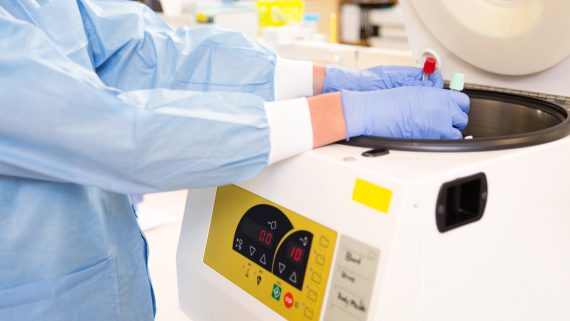
What Is Included in Every Centrifuge Calibration Service
- RPM / rotational speed verification at multiple set points using NIST-traceable optical tachometer
- Timer accuracy verification across the full range of programmed run times
- Temperature verification for refrigerated and heated centrifuge models
- Rotor inspection for cracks, corrosion, balance defects, and maximum-age compliance
- As-found data recording before any adjustment or correction (level-dependent)
- Adjustment or offset correction if instrument is found out of tolerance
- As-left data recording after adjustment and re-test (level-dependent)
- Calibration sticker with unique barcode for laboratory asset tracking
- Environmental condition documentation during calibration
- Happiness Guarantee on every service
Calibration sticker and basic performance verification — the standard choice for general research and internal quality programs that do not require a regulatory compliance certificate.
| Service Includes | Level 1 | Level 2 | Level 3 | Level 4 |
|---|---|---|---|---|
| RPM / Speed Verification (NIST-Traceable Tachometer) | ✔ | ✔ | ✔ | ✔ |
| Timer Accuracy Verification | ✔ | ✔ | ✔ | ✔ |
| Calibration Sticker with Barcode | ✔ | ✔ | ✔ | ✔ |
| Calibration Certificate with As-Left Data | – | ✔ | ✔ | ✔ |
| As-Found and As-Left Calibration Data | – | – | ✔ | ✔ |
| Documented Measurement Uncertainty | – | – | ✔ | ✔ |
| ISO/IEC 17025 Accredited Certificate | – | – | ✔ | ✔ |
| Options | ||||
|
Express Turnaround
24 hr / 48 hr / 72 hr
|
✔ | ✔ | ✔ | ✔ |
| Onsite Service at Your Facility | ✔ | ✔ | ✔ | ✔ |
| Rotor Inspection & Decontamination | ✔ | ✔ | ✔ | ✔ |
| Centrifuge Repair Services | ✔ | ✔ | ✔ | ✔ |
Level 3 and Level 4 calibration certificates satisfy CAP, CLIA, cGMP, GLP, and GxP documentation requirements for centrifuges and other separation equipment used in regulated laboratory and pharmaceutical manufacturing environments.
Centrifuge Calibration for Regulated and GMP Laboratories
Femto Scientific’s ISO/IEC 17025 accredited certificates and documentation meet the requirements of the most demanding regulatory frameworks for laboratory centrifuge equipment.
GMP & GxP — 21 CFR Parts 58, 210, 211
cGMP and GLP programs require centrifuge calibration records with unbroken NIST traceability, documented measurement uncertainty, and as-found/as-left data. Our ISO/IEC 17025 accredited certificates satisfy FDA 21 CFR requirements and support inspection readiness for all classes of laboratory separation equipment used in pharmaceutical manufacturing, QC testing, and cell culture programs.
CAP, CLIA & Clinical Laboratory Compliance
CAP and CLIA require documented, NIST-traceable calibration of centrifuges used in diagnostic testing, blood bank operations, and specimen processing. Our accredited certificates with as-found and as-left data satisfy CAP inspection checklists and CLIA quality system regulations — delivered electronically to your QMS or LIMS.
ISO 17025 & NIST-Traceable Rotor Speed Standards
Centrifuge RPM calibration requires NIST-traceable optical tachometers with current calibration certificates forming an unbroken traceability chain to national frequency and rotation standards. Femto Scientific’s ISO/IEC 17025 accredited certificates document this complete traceability chain, the measurement uncertainty of each RPM set point, and the environmental conditions during calibration — the evidence required by international quality auditors and regulatory inspectors.
Frequently Asked Questions About Centrifuge Calibration
Centrifuge calibration is the process of verifying that a centrifuge’s rotational speed (RPM), timer, and — for refrigerated models — temperature parameters conform to their specified values using NIST-traceable reference measurement standards. A calibration determines whether the centrifuge meets its accuracy specifications across the operating range. If any parameter is found out of tolerance, corrective action is taken before the as-left data is recorded. The resulting calibration certificate provides an audit-ready record of instrument performance with full traceability to NIST national measurement standards.
ISO/IEC 17025 centrifuge calibration is performed by a laboratory that has been independently assessed and accredited as technically competent by a recognized accreditation body. An ISO 17025 accredited centrifuge calibration certificate includes documented measurement uncertainty — a mandatory requirement for instrument qualification under GMP, GLP, FDA, CAP, and CLIA compliance programs. Without accreditation, a calibration certificate cannot demonstrate that the laboratory’s reference standards and measurement processes meet the technical competency requirements of these regulatory frameworks.
Centrifuges drift in speed accuracy over time due to motor wear, bearing degradation, belt slippage, and electronic component aging. An uncalibrated centrifuge operating at incorrect RPM can cause failed cell separations, compromised density-gradient results, incorrect clinical blood cell differentials, failed pharmaceutical manufacturing batches, and failed regulatory inspections. Regular calibration confirms that centrifuge speed, timer, and temperature parameters remain within their specifications — protecting research reproducibility, product quality, patient safety, and regulatory compliance.
Calibration frequency depends on regulatory requirements, instrument criticality, and usage intensity. Pharmaceutical laboratories under cGMP typically calibrate centrifuges annually, with frequency justified in the instrument qualification documentation. Clinical laboratories under CAP or CLIA are required to calibrate centrifuges at least annually. Research laboratories without regulatory mandates typically calibrate annually. High-criticality centrifuges — those used in GMP cell culture, blood processing, or pharmaceutical separation processes — may require semi-annual calibration. Femto Scientific can help you establish an appropriate calibration interval for your specific compliance program.
Centrifuge calibration typically verifies three primary performance parameters: RPM / rotational speed — measured at multiple set points across the instrument’s operating range using a NIST-traceable optical tachometer; timer accuracy — verified against a calibrated precision timing reference at multiple programmed run times; and temperature (for refrigerated and heated centrifuges) — verified using a NIST-traceable reference thermometer in the chamber or rotor area. Rotor inspection for physical defects, corrosion, and maximum-age compliance is also performed as part of a comprehensive centrifuge service visit.
Centrifuge Calibration Service Areas — Onsite & Nationwide Mail-In
Femto Scientific provides onsite centrifuge calibration in major laboratory markets across the United States. Laboratories outside our onsite territory can take advantage of our secure, fast-turnaround mail-in centrifuge calibration service with NIST traceable ISO 17025 accredited certificates delivered electronically.
- New York City, New York (NY) – Manhattan
- Somerset, New Jersey (NJ)
- Boston, Massachusetts (MA)
- Cambridge, Massachusetts (MA)
- Philadelphia, Pennsylvania (PA)
- Baltimore, Maryland (MD)
- Bethesda, Maryland (MD)
- New Haven, Connecticut (CT)
- Hartford, Connecticut (CT)
- Providence, Rhode Island (RI)
- Newark, Delaware (DE)
- Manchester, New Hampshire (NH)
- Rochester, New York (NY)
- Richmond, Virginia (VA)
- Durham, North Carolina (NC)
- Charlotte, North Carolina (NC)
- San Diego, California (CA)
- San Francisco, California (CA)
- Los Angeles, California (CA)
- Denver, Colorado (CO)
- Houston, Texas (TX)
- Phoenix, Arizona (AZ)
- St. Louis, Missouri (MO)
- Cincinnati, Ohio (OH)
- Cleveland, Ohio (OH)
- Indianapolis, Indiana (IN)
Mail-in centrifuge calibration service is available to any laboratory in the United States. Contact us for shipping instructions, packaging guidance, and a service quote.