
Femto Scientific delivers ISO/IEC 17025 accredited centrifuge calibration built for FDA 21 CFR Part 211 — with NIST-traceable RPM and timer verification, documented measurement uncertainty, and as-found/as-left data, so the microcentrifuges, refrigerated centrifuges, and ultracentrifuges behind your cell culture, separation, and QC processes pass inspection and your batch records hold up under audit.
- FDA 21 CFR Part 211 & Part 58 aligned records
- NIST-traceable tachometer & timer references
- As-found & as-left data for change control
- Multi-point RPM verification at your set points
- RCF / g-force accuracy derived from verified RPM
- Temperature verification for refrigerated models
- Documented measurement uncertainty (k=2)
- Onsite service with zero shipping downtime
Accredited centrifuge calibration your quality unit can defend against a data-integrity finding.
Why GMP Laboratories Require ISO 17025 Accredited Centrifuge Calibration
In a cGMP environment, every centrifuge is a critical instrument whose speed and timer accuracy flow directly into separation results, batch records, and release decisions. FDA 21 CFR Part 211 sets the calibration expectation; ISO/IEC 17025 accreditation provides the documented uncertainty and NIST traceability that prove the calibration can actually demonstrate compliance.
FDA 21 CFR Part 211 & Part 58
Instruments must be calibrated on a written schedule with limits, results, and remedial action recorded. Our certificates capture the calibration date, results, NIST traceability, and as-found/as-left data your quality unit needs for Part 211 cGMP and Part 58 GLP calibration programs.
RPM / RCF & Timer Verification
Rotational speed is verified at multiple set points with a NIST-traceable optical tachometer, and run timing against a precision timing reference. Because rated RCF (g-force) is derived directly from RPM, verified speed is what proves your separation conditions were what the protocol specified.
Data Integrity & Uncertainty
Without a reported measurement uncertainty, a certificate cannot demonstrate fitness for purpose. Accredited calibration with expanded uncertainty (k=2, 95%) gives you the attributable, accurate RPM and timer evidence auditors expect under ALCOA+ and 21 CFR Part 11.
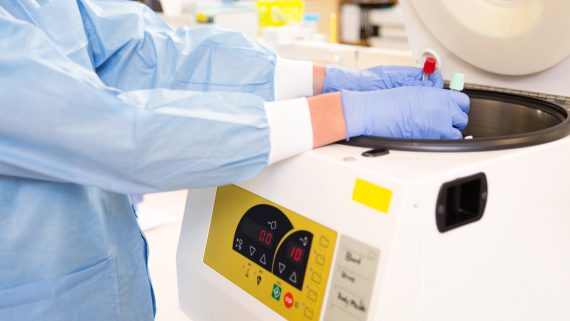
A Complete, Documented NIST-Traceable Calibration
Every accredited centrifuge calibration characterizes RPM and timer performance across your actual operating range — not just a single set point — and records as-found data so an out-of-tolerance finding can be impact-assessed under change control.
- Multi-point RPM verification at your protocol speeds
- Microcentrifuges, benchtop, high-speed & ultracentrifuges
- Temperature verification for refrigerated centrifuges
- Timer accuracy at programmed run times
- As-found & as-left data with adjustment
- Expanded measurement uncertainty (k=2)
Compare service levels and documentation on the centrifuge calibration service page, or see our CAP/CLIA clinical centrifuge calibration guide for diagnostic and blood bank requirements.
Pharmaceutical & GMP Centrifuge Calibration FAQs
Under FDA 21 CFR Part 211 (pharmaceutical GMP), all instruments used in drug manufacturing and testing — including centrifuges — must be calibrated according to a written program specifying frequency, calibration standards, limits, and corrective actions when results fall outside established limits. Calibration records must include the date of calibration, the calibration results, the identity of the person performing the calibration, and evidence of NIST traceability to national standards. Femto Scientific’s ISO 17025 calibration service delivers all required documentation in electronic format for integration into pharmaceutical quality management systems and 21 CFR Part 11 compliant LIMS platforms.
RPM (revolutions per minute) verification is the core measurement activity in centrifuge calibration. Using a NIST-traceable optical tachometer or stroboscope, the metrologist measures the actual rotational speed of the centrifuge rotor at multiple programmed speed set points across the instrument’s operating range. The measured values are compared against the displayed or set values to determine whether the centrifuge is operating within its manufacturer-specified accuracy tolerance. Any deviation is documented as as-found data; if adjustment is possible, it is performed and the post-adjustment as-left RPM values are measured and recorded. The centrifuge’s rated g-force values are directly derived from RPM accuracy, making this the most critical parameter in centrifuge calibration.
NIST traceable centrifuge calibration documents that the calibration results were obtained using measurement standards with an unbroken chain of comparisons to the National Institute of Standards and Technology (NIST) national measurement standards. For centrifuge RPM calibration, this means the optical tachometer used to measure rotational speed has a current calibration certificate tracing to NIST frequency and rotation standards. For timer calibration, the reference timing device is traceable to NIST time standards. Femto Scientific uses NIST-traceable optical tachometers and timing references with current calibration certificates maintained by our accredited laboratory.
Yes. Refrigerated centrifuge calibration includes all standard centrifuge parameters (RPM verification, timer accuracy) plus temperature verification in the rotor chamber using a NIST-traceable reference thermometer. Temperature accuracy is critical for refrigerated centrifuges used in cell culture, plasma preparation, protein isolation, and pharmaceutical manufacturing, where maintaining sample temperature during centrifugation is required for product quality and regulatory compliance. We calibrate refrigerated centrifuges from Thermo Scientific Sorvall, Beckman Coulter, Eppendorf, Hettich, and all other major manufacturers.
As-found data documents the centrifuge’s RPM accuracy, timer accuracy, and temperature performance before any adjustment during the calibration visit, providing a record of how the instrument was performing since the last calibration. As-left data documents performance after adjustment or correction, representing the condition in which the instrument was returned to service. Both data sets together provide before/after documentation required by GMP change control programs, CAP inspection checklists, and instrument qualification protocols. Femto Scientific’s Level 3 and Level 4 service levels include both as-found and as-left data.
Put Your Centrifuges on a Defensible GMP Calibration Program
Tell us your instrument count, types, and required service level — we’ll return a quote with turnaround options and a recommended calibration interval for your compliance program.