
Femto Scientific delivers ISO/IEC 17025 accredited thermometer calibration built for FDA 21 CFR Part 211 and USP Chapter <731> — with documented measurement uncertainty, as-found/as-left data, and unbroken NIST traceability to ITS-90, so the thermometers, probes, and data loggers behind your stability chambers, incubators, and autoclaves pass inspection and your temperature data holds up under audit.
- FDA 21 CFR Part 211 & Part 58 aligned records
- Documented measurement uncertainty (k=2)
- As-found & as-left data for change control
- Multi-point calibration at your set points
- USP Chapter <731> temperature compliance
- NIST-traceable references to ITS-90
- Onsite service with zero shipping downtime
- Electronic certificates for QMS / LIMS
Accredited thermometer calibration your quality unit can defend against a data-integrity finding.
Why GMP Laboratories Require ISO 17025 Accredited Thermometer Calibration
In a cGMP environment, every thermometer, RTD, thermocouple, and data logger is a measuring device whose accuracy flows directly into stability data, batch records, and release decisions. USP Chapter <731> and FDA 21 CFR Part 211 set the calibration expectations; ISO/IEC 17025 accreditation provides the documented uncertainty and ITS-90 traceability that prove the calibration can actually demonstrate compliance.
FDA 21 CFR Part 211 & Part 58
Instruments must be calibrated on a written schedule with limits, results, and remedial action recorded. Our certificates capture the calibration date, results, NIST traceability, and as-found/as-left data your quality unit needs for Part 211 cGMP and Part 58 GLP calibration programs.
USP Chapter <731> & ITS-90
USP <731> requires temperature-measuring instruments to be calibrated against NIST-traceable references at points that bracket the intended use range. We calibrate to ITS-90 per ASTM E220, E77, and E1137 and document every point with reported uncertainty.
Data Integrity & Uncertainty
Without a reported measurement uncertainty, a certificate cannot demonstrate fitness for purpose. Accredited calibration with expanded uncertainty (k=2, 95%) gives you the attributable, accurate temperature evidence auditors expect under ALCOA+ and 21 CFR Part 11.
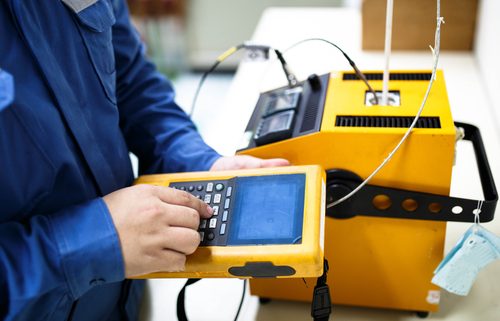
A Complete, Documented ITS-90 Traceable Calibration
Every accredited thermometer calibration characterizes performance across your actual use range — not just a single point — and records as-found data so an out-of-tolerance finding can be impact-assessed under change control.
- Multi-point calibration at your chamber set points
- Digital thermometers, RTDs, thermocouples & probes
- Temperature data loggers for stability monitoring
- As-found & as-left data with adjustment
- Expanded measurement uncertainty (k=2)
- NIST-traceable references to ITS-90
Compare service levels and documentation on the thermometer calibration service page, or see our temperature & humidity mapping for the chamber and storage studies your calibrated probes support.
Pharmaceutical & GMP Thermometer Calibration FAQs
Under FDA 21 CFR Part 211 (pharmaceutical GMP), all instruments used in drug manufacturing and testing — including thermometers — must be calibrated according to a written program specifying frequency, calibration standards, limits, and corrective actions when results fall outside established limits. Calibration records must include the date of calibration, the calibration results, the identity of the person performing the calibration, and evidence of NIST traceability to national standards. Femto Scientific’s ISO 17025 calibration service delivers all required documentation in electronic format for integration into pharmaceutical quality management systems and 21 CFR Part 11 compliant LIMS platforms.
Measurement uncertainty quantifies the range within which the true temperature value is expected to lie at a stated confidence level. In thermometer calibration, uncertainty is calculated by combining contributions from the reference standard, the calibration bath or dry-block stability, the thermometer’s repeatability, and other sources using the GUM (Guide to the Expression of Uncertainty in Measurement) methodology. ISO/IEC 17025 accredited calibration certificates include a documented expanded uncertainty statement (typically at the 95% confidence level, k=2). This uncertainty value is required for GMP instrument qualification, USP compliance, and FDA submissions. Without a reported uncertainty value, a calibration certificate cannot be used to demonstrate fitness for purpose under regulatory frameworks.
Calibration frequency depends on regulatory requirements, instrument criticality, and usage intensity. Pharmaceutical laboratories under cGMP typically calibrate critical thermometers every 6 months or annually, with frequency justified in the instrument qualification documentation. Clinical laboratories under CAP or CLIA are required to calibrate temperature-measuring equipment at least annually. Research laboratories without regulatory mandates typically calibrate annually. High-criticality thermometers — those used in incubators, stability chambers, autoclave validation, or freeze-thaw studies — may require quarterly calibration. Femto Scientific can help you establish and document an appropriate calibration interval for your specific compliance program.
Laboratory thermometer calibration is governed by several overlapping standards depending on the instrument type: ASTM E220 (calibration of thermocouples by comparison techniques); ASTM E77 (inspection and verification of liquid-in-glass thermometers); ASTM E1137 (industrial platinum resistance thermometers); ITS-90 (International Temperature Scale of 1990 — the basis for NIST traceability in temperature); NIST SP 250-23 (NIST calibration services for liquid-in-glass thermometers); and ISO/IEC 17025:2017 (general requirements for the competence of calibration laboratories). Regulatory compliance frameworks including FDA 21 CFR Part 211, CAP, CLIA, and USP Chapter <731> require calibration to be performed in accordance with these technical standards.
As-found data documents the thermometer’s measurement performance before any adjustment or correction during the calibration visit, providing a record of how the instrument was performing since the last calibration. As-left data documents performance after adjustment or correction, representing the condition in which the instrument was returned to service. Both data sets together provide before/after documentation required by GMP change control programs, CAP inspection checklists, and instrument qualification protocols. Femto Scientific’s Level 3 and Level 4 service levels include both as-found and as-left data.
Put Your Thermometers on a Defensible GMP Calibration Program
Tell us your instrument count, types, and required service level — we’ll return a quote with turnaround options and a recommended calibration interval for your compliance program.