
Femto Scientific provides ISO/IEC 17025 accredited HPLC preventative maintenance and qualification that keeps clinical and diagnostic laboratories CAP- and CLIA-ready — NIST-traceable service reports with as-found and as-left data and documented uncertainty for the LC and LC-MS systems running therapeutic drug monitoring, toxicology, and laboratory-developed test (LDT) methods.
- Qualified for survey with as-found data
- NIST-traceable flow rate verification
- As-found & as-left data on every report
- Documented measurement uncertainty (k=2)
- Survey- and inspection-ready documentation
- Onsite service for high-volume clinical labs
- LC-MS & UHPLC preventative maintenance
- Automatic requalification scheduling
HPLC qualification records your CAP inspector can check off without a second question.
HPLC Qualification Requirements for CAP and CLIA Laboratories
Clinical laboratories accredited by the College of American Pathologists (CAP) or operating under CLIA must maintain calibration and preventative-maintenance records for every instrument that affects test results — including the HPLC and LC-MS systems running therapeutic drug monitoring, toxicology, and LDT methods. ISO/IEC 17025 accredited qualification is the cleanest way to demonstrate that competency for survey.
CAP Survey Readiness
CAP laboratory accreditation program (LAP) checklists require documented calibration, function checks, and preventative maintenance for the analytical instruments used in patient testing. Our service reports document NIST-traceable flow rate verification, the service date, as-found/as-left results, and reported uncertainty — exactly what surveyors expect.
CLIA 42 CFR 493.1254
CLIA requires instrument maintenance and function checks to be performed per manufacturer and quality-standard specifications, with calibration verification within the established interval. Our accredited service reports meet those requirements for high-complexity HPLC and LC-MS testing and integrate with your LIS.
LDT & Method Verification
For laboratory-developed tests and modified FDA-cleared methods, the HPLC must be shown to perform within the validated method’s parameters. Accredited qualification with documented flow rate, detector, and system suitability data gives you the instrument evidence to support LDT verification — and to scope any impact if a system is found out of tolerance.
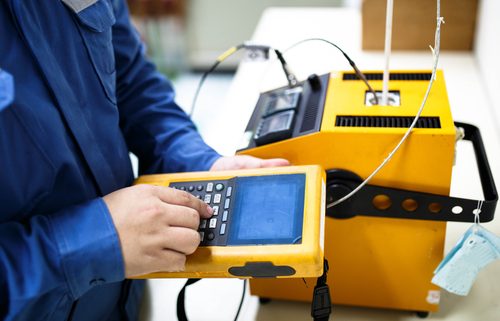
A Full Qualification, Not Just a Function Check
A daily system suitability run confirms performance for one sequence; it is not an instrument qualification. Accredited HPLC qualification characterizes flow rate, gradient, detector, and autosampler performance against acceptance criteria and documents it for CAP and CLIA compliance. Both belong in your quality program — serving different purposes.
- Flow rate accuracy across the clinical method range
- Detector wavelength accuracy & linearity (UV/Vis, PDA, FLD)
- Autosampler injection precision & carryover
- Documented expanded uncertainty (k=2)
- Barcode calibration stickers for asset tracking
- Electronic service reports for paperless QMS
Most CAP and CLIA laboratories qualify analytical instruments at least annually. Compare service levels and turnaround on the HPLC preventative maintenance service page, or see our pharmaceutical & GMP HPLC guide for cGMP qualification requirements.
CAP & CLIA HPLC Qualification FAQs
HPLC service frequency depends on regulatory requirements, usage intensity, and mobile phase aggressiveness. Pharmaceutical laboratories under cGMP typically service HPLC systems every 6 months. Clinical laboratories under CAP or CLIA service instruments annually at minimum. Research laboratories without direct regulatory requirements typically service annually. High-use instruments running continuous sample loads, aggressive mobile phases (high-salt buffers, TFA-containing methods, basic mobile phases), or instruments with aging pump seals may require more frequent service. Any HPLC that has been repaired, relocated, or produced unexpected chromatographic results (retention time shifts, peak shape changes, pressure anomalies) should be evaluated before returning to critical analytical use.
FDA-compliant HPLC qualification documentation must include: a qualification protocol (approved prior to testing) specifying the tests to be performed, acceptance criteria, equipment to be used, and the qualification scope; test execution records documenting actual results, deviations, and the identity of the personnel performing and reviewing each test; a qualification report summarizing results, deviations, and a final disposition (pass/fail); and an equipment qualification certificate confirming the instrument is qualified for its intended use. All documentation must meet 21 CFR Part 11 requirements if maintained electronically — including audit trails, controlled access, and version control. Femto Scientific provides all qualification documentation in PDF format signed by the service engineer, with document revision control headers suitable for upload to validated quality document management systems.
System suitability is the test performed at the beginning of each HPLC analytical sequence to verify that the complete system — instrument, column, mobile phase, and reference standard — is performing adequately for the intended analysis. System suitability parameters (plate count, tailing factor, resolution, RSD of replicate injections, and retention time reproducibility) are specified in the method and must meet defined acceptance criteria before analytical results can be reported. System suitability is a USP and ICH Q2(R2) requirement for validated pharmaceutical HPLC methods and is expected by FDA inspectors as evidence of day-to-day analytical system control. A PM program that verifies flow rate accuracy, detector performance, and system suitability provides documented evidence that the instrument is performing within its qualified state and that system suitability is being controlled proactively, not just reactively when failures occur.
Regulatory requirements do not explicitly prohibit using a non-accredited vendor for HPLC qualification, but there are significant practical and compliance implications. For GMP laboratories, the qualification report and supporting test data must be defensible to FDA inspectors. A vendor without ISO/IEC 17025 accreditation for flow rate measurement and detector qualification cannot provide documented measurement uncertainty, which means the test results cannot be placed in a metrological context. FDA inspectors increasingly ask for uncertainty statements and traceability documentation that only accredited laboratories can provide. For laboratories seeking the highest level of audit readiness, Femto Scientific’s ISO/IEC 17025 accredited Level 3 and Level 4 service packages provide the defensible, metrologically traceable qualification documentation that withstands the most rigorous FDA and CAP scrutiny.
Yes. Femto Scientific provides onsite HPLC preventative maintenance, IQ/OQ/PQ qualification, and repair across major U.S. laboratory markets including New York, New Jersey, Boston, Philadelphia, Baltimore, Connecticut, California, Texas, and many more. Onsite service eliminates shipping risk, minimizes instrument downtime, and is the preferred option for GMP facilities that require witnessed qualification, multi-module HPLC systems, and laboratories managing large HPLC fleets. For laboratories outside our direct service territory, we offer depot repair and qualification at our ISO 17025 accredited laboratory in Somerset, NJ. Contact us to confirm scheduling availability in your location.
Keep Every Clinical HPLC Survey-Ready
Send us your instrument count and configurations — we’ll return a quote with turnaround options and a recommended qualification interval that keeps your laboratory inside CAP and CLIA requirements year-round.