
Femto Scientific delivers NSF/ANSI 49 biosafety cabinet certification built for USP Chapter <797> and USP Chapter <800> sterile and hazardous-drug compounding — semi-annual certification of your primary engineering controls, ISO 14644-1 particle-count classification, and HEPA filter integrity testing, performed with NIST-traceable, ISO/IEC 17025-calibrated instruments so the cabinets, isolators, and cleanrooms behind your aseptic process pass state board of pharmacy inspection and FDA audit.
- USP <797> semi-annual PEC certification
- USP <800> C-PEC containment verification
- ISO 14644-1 cleanroom particle counts
- HEPA integrity (PAO/DOP) aerosol scan
- NSF/ANSI 49 primary-engineering-control testing
- NIST-traceable, ISO 17025-calibrated instruments
- CETA-certified field technicians
- GMP validation (IQ/OQ/PQ) documentation
Aseptic-process certification your quality unit can defend against a USP or FDA finding.
Why GMP & Compounding Facilities Require Accredited NSF/ANSI 49 Certification
In a cGMP or sterile-compounding environment, every biosafety cabinet, laminar flow hood, and containment isolator is a primary engineering control whose airflow and HEPA performance directly protect product sterility and personnel safety. USP <797>, USP <800>, and FDA 21 CFR Part 211 set the certification expectations; NSF/ANSI 49 testing with NIST-traceable, ISO/IEC 17025-calibrated instruments provides the documented, defensible evidence that the control actually performs.
USP <797> & USP <800>
Sterile compounding requires ISO 5 primary engineering controls to be certified every 6 months; hazardous-drug compounding adds negative-pressure containment (C-PEC / C-SEC) verification. We certify PECs, buffer rooms, and ante-rooms with ISO 14644-1 particle counts, HEPA integrity, and room pressurization, documented for pharmacy board inspection.
FDA 21 CFR Part 211 & Validation
cGMP manufacturing keeps containment controls in a validated state through a qualification lifecycle. Our IQ/OQ/PQ validation packages document NSF/ANSI 49 Annex F performance, instrument traceability, and deviation handling for inclusion in your equipment qualification master file.
NSF/ANSI 49 & ISO 14644
Every certification tests inflow and downflow velocity, HEPA filter integrity (PAO/DOP aerosol scan), containment, and smoke-pattern airflow against NSF/ANSI 49 tolerances — complemented by ISO 14644-1 classification of the surrounding cleanroom for a complete, audit-ready record.
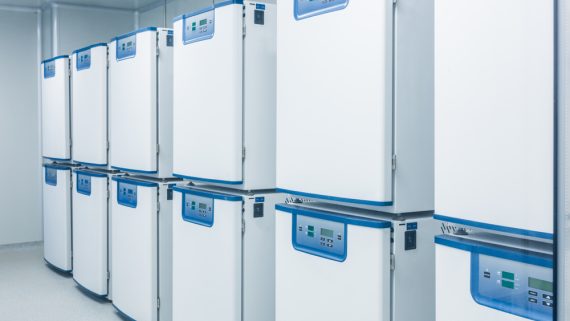
A Complete, Documented Primary-Engineering-Control Certification
Every certification characterizes airflow and HEPA performance across the whole control — not a single reading — and records as-found data so an out-of-tolerance result can be impact-assessed under change control before your next compounding batch.
- Inflow & downflow velocity per NSF/ANSI 49
- HEPA integrity (PAO/DOP) scan of supply & exhaust
- ISO 5 critical-zone particle counts for PECs
- Room pressurization & ISO 14644-1 classification
- Containment & smoke-pattern airflow verification
- IQ/OQ/PQ validation documentation
Compare certification levels and documentation on the biosafety cabinet & cleanroom certification service page, or see how we keep clinical labs survey-ready in our CAP/CLIA certification guide.
Pharmaceutical & GMP Biosafety Cabinet Certification FAQs
A complete NSF/ANSI 49 biosafety cabinet certification includes the following tests: (1) Inflow velocity testing — measuring air velocity entering the cabinet at the work opening to verify personnel protection; (2) Downflow velocity testing — measuring airflow across the work surface at a defined grid per NSF/ANSI 49 and manufacturer specifications; (3) HEPA filter integrity testing (PAO/DOP scan) — scanning the HEPA supply and exhaust filters for leaks and defects; (4) Cabinet containment testing — verifying that the cabinet prevents outward leakage of aerosolized agents; (5) Smoke pattern testing — airflow visualization confirming unidirectional flow and containment at the work opening; (6) Alarm and safety system verification; and (7) Electrical safety check including lighting, UV lamp output, and blower motor performance.
HEPA (High Efficiency Particulate Air) filter integrity testing verifies that the filter is removing at least 99.99% of challenge aerosol particles at every point across its face — not just as a bulk average. A HEPA filter rated at 99.99% efficiency that has a single pinhole leak in the filter media or a gap in the filter-to-frame seal can allow unfiltered aerosol to bypass the filter entirely at that location. The PAO/DOP challenge test detects these localized failures that bulk efficiency testing cannot identify. During the test, a calibrated aerosol photometer scans the entire downstream face of the filter at approximately 2 cm from the surface, at a scan rate of approximately 5 cm/second. Any point reading exceeding 0.01% of upstream challenge concentration is flagged as a leak. The most common failure locations are the filter-to-frame seal (which degrades with age and thermal cycling) and the frame-to-cabinet seal (which can be compromised during shipping or improper installation). HEPA filter integrity is the single most important test in BSC certification — a cabinet can have perfect inflow velocity and still be unsafe if its HEPA filter has a pinhole leak.
A compounding aseptic isolator (CAI) is an enclosed glove-port workstation that maintains ISO 5 air quality inside a sealed, positive-pressure (for non-hazardous sterile compounding) or negative-pressure (for hazardous drug compounding — containment aseptic isolator, or CAI for hazardous drugs) enclosure. Unlike open-front biosafety cabinets, isolators use a physical barrier (glove ports and sleeve assemblies) between the operator and the work zone, providing a higher level of containment than open-front BSCs for many applications. Isolators used for sterile compounding under USP <797> must be certified semi-annually to the same ISO 5 particle count and HEPA integrity specifications as open-front laminar flow hoods and biosafety cabinets. Containment aseptic isolators used for hazardous drugs under USP <800> must maintain negative pressure verified at each certification visit. Certification of isolators follows CETA Application Guide CAG-003 and the manufacturer's specific test protocol, and requires specialized equipment including aerosol generators that can challenge filters through the glove port access. Femto Scientific certifies all major isolator platforms including those from Germfree, Baker, and Esco.
A GMP validation package for biosafety cabinet certification is a comprehensive documentation set that supports the qualification lifecycle for biosafety cabinets used in cGMP pharmaceutical or biopharmaceutical manufacturing environments. The package typically includes: (1) Installation Qualification (IQ) documentation — cabinet make, model, serial number, installation location, electrical specifications, exhaust duct connection type, and comparison against procurement specifications; (2) Operational Qualification (OQ) documentation — performance verification per NSF/ANSI 49 Annex F for all test parameters, with all measured values, instruments used, calibration certificates for instruments, and pass/fail determinations; (3) Performance Qualification (PQ) documentation — operational performance under simulated or actual production conditions, including airflow pattern visualization and any product-specific contamination risk assessments; (4) Periodic re-qualification schedule — defined based on risk assessment, typically semi-annually or annually; (5) Change control documentation — referencing any HVAC changes, HEPA filter replacements, or maintenance performed since the last qualification. GMP validation packages are formatted to comply with 21 CFR Part 211 quality system requirements and are suitable for inclusion in the equipment qualification master file. Femto Scientific provides IQ/OQ/PQ documentation packages for all containment device qualifications in GMP environments; contact our validation services team to discuss specific documentation requirements for your facility.
The standard industry requirement, per CDC/NIH biosafety guidelines, NSF/ANSI 49, and most institutional biosafety programs, is that biosafety cabinets be certified annually under normal operating conditions. Additional certification is required after any event that may affect cabinet performance: relocation or movement of the cabinet (even within the same room); replacement of HEPA filters or major components; repair to the cabinet frame, blower, or internal structure; after work with highly hazardous agents requiring decontamination; or after extended periods of non-use. Compounding pharmacies operating under USP <797> must certify primary engineering controls every 6 months. Contact Femto Scientific to establish a certification schedule appropriate for your specific compliance program.
Put Your Primary Engineering Controls on a Defensible USP Certification Schedule
Tell us your cabinet, isolator, and cleanroom count and your compliance framework — we’ll return a quote with turnaround options and a semi-annual certification schedule that keeps you inside USP <797>, USP <800>, and cGMP requirements.