
Femto Scientific provides ISO/IEC 17025 accredited balance calibration that keeps clinical and diagnostic laboratories CAP- and CLIA-ready — NIST-traceable certificates with as-found and as-left data and documented uncertainty that hold up to survey and keep your diagnostic weighings defensible.
- Calibrated to ensure accuracy for survey
- NIST-traceable OIML Class E2 / F1 weights
- As-found & as-left data on every certificate
- Documented measurement uncertainty (k=2)
- Survey- and inspection-ready documentation
- Onsite service for high-volume labs
- Electronic certificates for LIMS
- Automatic recertification scheduling
Balance calibration records your CAP inspector can check off without a second question.
Balance Calibration Requirements for CAP and CLIA Laboratories
Clinical laboratories accredited by the College of American Pathologists (CAP) or operating under CLIA must calibrate weighing equipment with NIST-traceable standards and keep the records available for survey. ISO/IEC 17025 accredited calibration is the cleanest way to demonstrate that competency.
CAP Survey Readiness
CAP reviews calibration records for weighing devices as part of the laboratory’s quality management assessment. Our certificates document NIST-traceable calibration, the calibration date, as-found/as-left results, and reported uncertainty — exactly what surveyors expect.
CLIA 42 CFR 493.1252
CLIA requires instruments to be maintained and calibrated per manufacturer and quality-standard specifications, using NIST-traceable references within the established interval. Our accredited certificates meet those requirements and integrate with your LIMS.
Defensible Diagnostic Results
An out-of-tolerance balance can shift patient results. Accredited calibration with documented uncertainty and as-found data gives you the evidence to demonstrate weighing validity — and to scope any impact if an instrument is found out of tolerance.
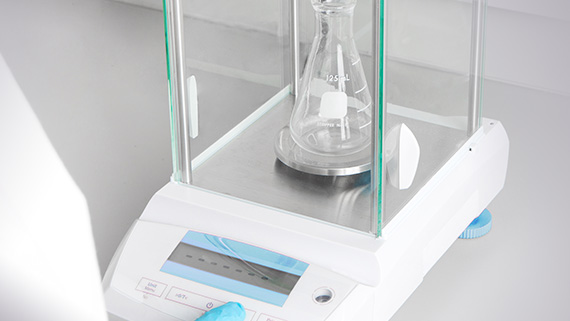
A Full Calibration, Not Just a Span Check
A daily user check confirms a single point; it is not a calibration. Accredited calibration characterizes full weighing performance with NIST-traceable weights and documents it for CAP and CLIA compliance. Both belong in your quality program — serving different purposes.
- Sensitivity / linearity across full capacity
- Repeatability and corner-load testing
- As-found & as-left data with adjustment
- Documented expanded uncertainty (k=2)
- Barcode calibration stickers for asset tracking
- Electronic certificates for paperless QMS
Most CAP and CLIA laboratories calibrate weighing equipment at least annually. Compare service levels and turnaround on the balance calibration service page.
CAP & CLIA Balance Calibration FAQs
Calibration frequency depends on regulatory requirements, instrument criticality, and usage intensity. Pharmaceutical laboratories operating under cGMP typically calibrate analytical balances every 6 months. Clinical laboratories under CAP or CLIA are required to calibrate weighing equipment at least annually. Research laboratories without regulatory mandates typically calibrate annually. High-use or high-criticality balances — those used in drug dispensing, primary reference standard weighing, or GMP manufacturing — may require quarterly calibration. Femto Scientific can help you establish and document a calibration interval appropriate for your specific compliance program and instrument usage patterns.
As-found data documents the balance’s measurement performance before any adjustment or repair during the calibration visit, providing a record of how the instrument was performing in your laboratory since the last calibration. As-left data documents performance after adjustment and/or repair, representing the condition in which the instrument was returned to service. Both data sets together provide before/after documentation required by GMP change control programs, CAP checklists, and instrument qualification protocols. Femto Scientific’s ISO 17025 and On-Site service levels include both as-found and as-left data.
All service levels include a calibration sticker with barcode applied to the instrument. The Full, ISO 17025, and On-Site levels include an electronic calibration certificate documenting as-left measurement data. The ISO 17025 and On-Site levels additionally include as-found measurement data, documented expanded measurement uncertainty (k=2, 95% confidence), reference weight certificate traceability references, environmental conditions during calibration, and the ISO/IEC 17025 accredited laboratory identifier. Certificates are delivered electronically in PDF format and are formatted for integration with quality management systems (QMS) and laboratory information management systems (LIMS).
NIST traceable balance calibration documents that the calibration results were obtained using measurement standards with an unbroken chain of comparisons to the National Institute of Standards and Technology (NIST) national measurement standards. Femto Scientific uses OIML Class E2 and Class F1 reference weights that are calibrated against NIST-certified standards and recertified on a regular schedule. This unbroken traceability chain is required by FDA, CAP, CLIA, and ISO programs as evidence that your balance’s measurement results are metrologically valid and comparable to international measurement references.
Yes. Femto Scientific provides onsite balance calibration and repair across major U.S. laboratory markets including New York, New Jersey, Boston, Philadelphia, Baltimore, Connecticut, California, Texas, and many more cities. Onsite service is available at all service levels and is ideal for large platform scales, instruments that are difficult to ship, or laboratories that require zero instrument downtime. Laboratories outside our direct service territory can use our secure, fast-turnaround mail-in balance calibration service with NIST traceable certificates delivered electronically.
Keep Every Clinical Balance Survey-Ready
Send us your instrument count and brands — we’ll return a quote with turnaround options and a recommended calibration interval that keeps your laboratory inside CAP and CLIA requirements year-round.