
Femto Scientific delivers ISO/IEC 17025 accredited autoclave calibration and steam sterilizer validation built for FDA 21 CFR Part 211 and ISO 17665 — IQ/OQ/PQ qualification, thermal distribution and heat-penetration studies, F0 lethality and sterility assurance level (SAL) confirmation, and biological indicator verification, all backed by NIST-traceable temperature and pressure standards so your terminal sterilization process holds up under FDA inspection.
- FDA 21 CFR Parts 210/211 & Part 58 aligned records
- IQ/OQ/PQ qualification protocols
- Documented measurement uncertainty (k=2)
- As-found & as-left data for change control
- ISO 17665 moist-heat validation
- Thermal mapping & heat-penetration studies
- F0 lethality & SAL 10-6 confirmation
- Biological indicator verification
Accredited autoclave validation your quality unit can defend against a sterility-assurance finding.
Why GMP Facilities Require ISO 17025 Accredited Autoclave Calibration & Validation
In a cGMP environment, terminal sterilization is a process whose result cannot be verified by inspecting the finished product — it must be validated. FDA 21 CFR Part 211 and ISO 17665 set the qualification expectations; ISO/IEC 17025 accreditation provides the documented measurement uncertainty and unbroken NIST traceability that prove the calibrated temperature and pressure data behind your IQ/OQ/PQ can actually demonstrate compliance.
FDA 21 CFR Part 211 & Process Validation
21 CFR 211.63/211.67/211.68 require sterilization equipment to be qualified, calibrated on a written schedule, and revalidated after significant change. The FDA Process Validation Guidance (2011) aligns Stage 2 process qualification with IQ/OQ/PQ. Our certificates capture the calibration date, results, NIST traceability, and as-found/as-left data your quality unit needs for a defensible autoclave program.
ISO 17665 Moist-Heat Sterilization
ISO 17665 governs the development, validation, and routine control of moist-heat sterilization. Our validation protocols characterize temperature distribution in the empty and loaded chamber, demonstrate heat penetration and biological efficacy at the worst-case position, and confirm reproducibility across consecutive runs — with every thermal study performed using calibrated, NIST-traceable dataloggers.
F0 Lethality, SAL & Data Integrity
Sterility assurance is only as trustworthy as the temperature data behind the F0 calculation. Accredited calibration with expanded uncertainty (k=2, 95%) gives you attributable, accurate time-temperature evidence to confirm a delivered F0 and a SAL of 10-6 at the coldest point — the ALCOA+ and 21 CFR Part 11 record auditors expect.
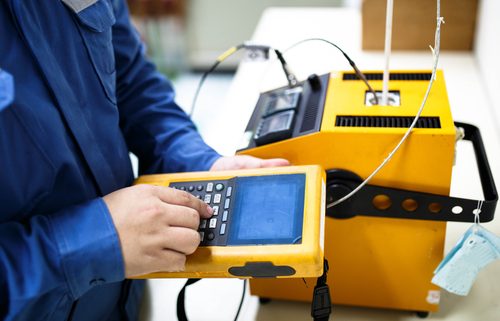
A Complete, Documented IQ/OQ/PQ Validation Package
Every accredited autoclave validation qualifies performance under your actual load configurations — not just an empty chamber — and records as-found data so an out-of-tolerance sensor can be impact-assessed under change control.
- NIST-traceable temperature, pressure & timer calibration
- Installation & Operational Qualification (IQ/OQ)
- Empty and loaded chamber thermal distribution studies
- Heat-penetration testing & F0 lethality calculation
- Biological indicator verification (G. stearothermophilus)
- Bowie-Dick & vacuum leak testing for pre-vacuum sterilizers
Compare service levels and the full validation package on the autoclave calibration & validation service page, or see our guide for CAP/CLIA clinical autoclave validation.
Pharmaceutical & GMP Autoclave Validation FAQs
Yes. FDA 21 CFR Parts 210/211 require that all manufacturing processes, including sterilization, be validated before implementation and revalidated following significant changes. GMP regulations require documented IQ/OQ/PQ qualification for any autoclave used in drug product manufacturing, sterility testing, or equipment sterilization in a regulated environment. The FDA Process Validation Guidance (2011) establishes the framework that aligns with IQ/OQ/PQ for autoclave qualification. Unvalidated sterilization processes in GMP facilities are a significant FDA 483 observation and warning letter finding.
cGMP (current Good Manufacturing Practice) autoclave qualification is the IQ/OQ/PQ qualification process performed in accordance with FDA current GMP regulations (21 CFR Parts 210/211) and industry guidance documents (FDA Process Validation Guidance 2011, WHO TRS 961, ICH Q8/Q9/Q10). cGMP qualification requires: formal approval of qualification protocols before execution; NIST-traceable calibration of all instruments; three or more consecutive successful qualification runs; documented deviations and resolution; and formal approval of the qualification summary report by a qualified person. Our qualification documentation is designed to meet FDA current expectations for autoclave qualification in pharmaceutical manufacturing environments.
ISO 17665-1:2006 requires: definition of sterilization process parameters; demonstration of process controllability and reproducibility (OQ); temperature distribution characterization in empty and loaded chamber; demonstration of biological efficacy at the worst-case position; documented review and approval of all validation data; and a defined requalification program with specified trigger conditions. The standard applies to moist heat sterilization of medical devices but is widely used as the technical framework for pharmaceutical autoclave validation as well. Femto Scientific’s validation protocols are developed in compliance with ISO 17665 requirements.
A heat penetration study measures temperature inside the items being sterilized — not just in the chamber air — to confirm that heat has adequately penetrated to the core of the load. Probes are placed at the position expected to be hardest to heat within the load (the cold spot). Results are used to calculate the F0 lethality delivered at the worst-case position and to confirm that the sterilization cycle achieves the required SAL throughout the entire load. Heat penetration testing is performed during PQ and must be repeated whenever the load configuration changes significantly.
A biological indicator (BI) study uses spore preparations of highly heat-resistant organisms (typically Geobacillus stearothermophilus with 105–106 spores per unit) placed at worst-case positions in the autoclave chamber during PQ validation runs. After the sterilization cycle, BIs are incubated and monitored for growth. A negative result at all BI positions (confirmed by positive growth controls) provides direct microbiological evidence that the cycle achieved SAL 10⁻⁶ or better. BI studies are required for initial PQ, periodic requalification in GMP environments, and validation of any new load type or cycle modification.
Put Your Autoclaves on a Defensible GMP Validation Program
Tell us your autoclave count, types, and required scope — calibration, IQ/OQ/PQ, or full sterilization validation — and we’ll return a quote with turnaround options and a recommended requalification interval for your compliance program.